THE IMPACT OF SOCIAL MEDIA ON THE FASHION INDUSTRY

It’s no secret that social media influences just about every aspect of our daily lives. From sports to politics to news, our choice of online interactions defines who we are and what we do. Fashion is no exception. Social media in the fashion industry refers to how brands in the named sector connect with their target market through social media outlets such as Facebook, Twitter and YouTube. Fashion brands most often utilize social media for advertising. Other uses include reporting news, updates, announcements, events, promotions, and customer service. For example, organizations can use Facebook to promote events and give full news stories. They can use Twitter for shorter updates and announcements. The company decides which sites to use and controls how these sites display their image. Companies’ awareness of society’s dependence on technology drives them to delve into social media.
LUXURY, FASHION, AND SOCIAL MEDIA
Social media are a marketing strategy to manage market shrinkage in fashion and luxury markets. During the financial crisis of 2008, retailers faced a dilemma relating to both the economic environment and psychographic issues: how to convince consumers of fashion and luxury goods to purchase when even the wealthy cut back, and how to plan for spring when sales are declining at retail stores. Neither designers nor retailers expected improvements,consequently, a growing number of designers sought new marketing strategies to appeal to customers’ emotions. Customers became more aware of the value of the goods they were purchasing, especially at high prices, therefore, designers had to be bolder, crazier and make something that really stood out to sell successfully.
 |
| Balmain using social media stars and models with millions of Instagram followers for the SS 2015 campaign |
The usage of social media technology by luxury brands started in 2009 and was initially believed to weaken the relationship with consumers, however, it is now viewed as an opportunity to improve customer relationships and to ultimately capture and connect with a larger audience. Technology encourages customers to interact with brands while increasing brand awareness involvement,and engagement. Thus, adding to brand recall and stimulating purchases. New media helped Diane von Furstenberg make a dramatic comeback to fashion industry. Her holistic methods of reaching consumers include a variety of new media technologies such as her website, Facebook page, blog, and Twitter page. DVF has managed to use these sources collectively to redefine her brand and draw in a younger clientele. Her brand is also well-known for its transparency and she shares every
aspect of her line and her life with her fans, von Furstenberg’s followers are loyal key

Burberry´s Art of The Trench
influencers whose voices hold a certain amount of authority not only in the fashion industry but also in high-tech social circles. Luxury brands such as Burberry have begun using new media as a way of making consumers feel more connected to the brand. Burberry describes its site The Art of The Trench as "a living document between the trench coat and the people who wear it". Wearers of the iconic trench can submit images of themselves and be featured online along with other fans of Burberry creating a sense of exclusiveness and community.

INSTANT INSIGHT
The use of social media by fashion insiders is artificially speeding up the fashion calendar, because customers are seeing fashion instantly as it hits the runway. Josh Newis-Smith, the junior fahion editor for Grazia magazine reckons this obsession with capturing and sharing every earring and handbag on the runway is changing how the fashion industry works. "We're all watching a show through our phone, rather than our eyes," he says. "Social media is now so relentless, you are spending your whole time on Instagram, Snapchat, Twitter, Periscope... Everything needs to be instant." September is the time designers reveal their collections for the following spring and summer.
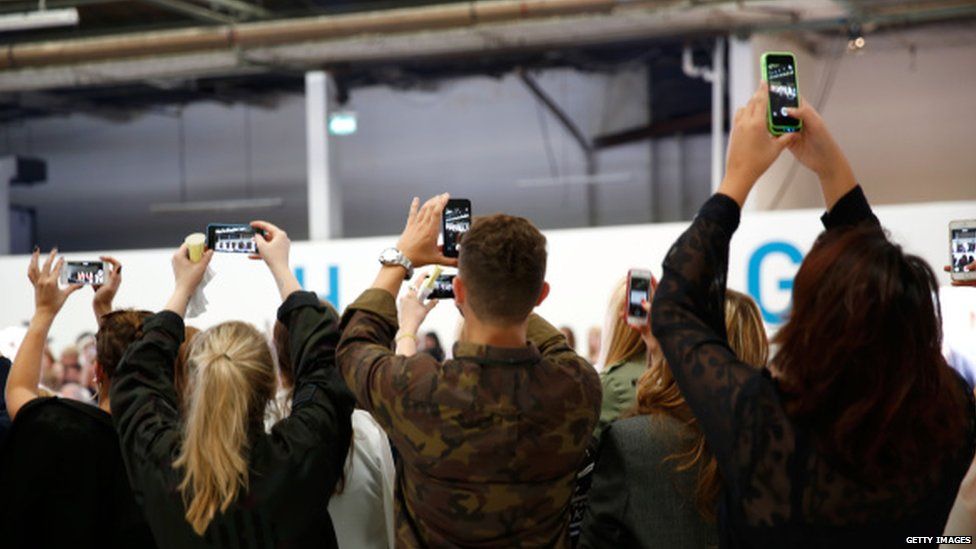 |
| Mobile style at London Fashion Week |
A fashion show is not a closed off experience only to be seen by the chosen ones anymore, in the old days, the spring summer collections were seen by customers only in magazines in the following February. This speed up has had a major influence especially on high street brands such as Zara,Topshop or online-only retailer Asos, they have enough resources to create collections inspired by the current fashion month in a matter of weeks and that´s exactly what customers want. By the time designers clothes have got into the stores, the high street has already interpreted their look several ways,it is good for customers, but experts are aware that at some point this pace needs to slow down.
NEW AGE INTERACTION

Instagram fashion accounts with most followers
In the fashion industry, social media platforms can be used to interact with the consumer, as a means of networking with others in the industry, and as a way of building an online presence. But social media can also influence designers in unique ways that are changing the way many designers create their fashions.It’s not just the inspiration and influences on major fashion designers that social media is evolving; it’s also the way we view fashion and the industry as a whole. For decades, a few big names dominated the fashion industry in a very top-down fashion but now social media has acted as a catapult to push the “unknowns” into situations where they can make their designs and ideas known to millions.The Blogger´s effectiveness is due to a strong individual, personal, popular, and elitist point of view. The engaging experience of a blog offers readers the opportunity to voice opinions and challenge fashion critics.Once considered fashion-obsessed amateurs, now brands view popular bloggers as the new journalists, influencers and trendsetters.
Social media sites act as a platform for the average person, and major fashion designers know these people are out there so they can also reap benefits by reaching customers on a new level that is more intimate and interactive, rather than the highfalutin fashion runways. A study from eBay Deals shows that more people are using social media for wardrobe advice, inspiration and the latest trends and fashion related Tweets doubled from the same event just a year earlier. From people sharing Instagram photos and Tweets from the sidelines of top fashion runways, people from home can interact and engage in the fashion shows just like the attendees.
Elitism within fashion has been hugely eroded, and this is for the best. The floodgates have been opened to a new generation – young creatives of multifaceted and sometimes-obscure talents that challenge preconceptions and convention.

Most influential fashion bloggers of now
THE EXTENT OF INFLUENCE
In this new day and age young shoppers are making important decisions online and learning about fashion via blogs rather than via fashion magazines. What follows is a democratisation of opinion, as young fashionistas can connect with people who really matter to them like designers rather than the traditional journalists. Facebook influences shopping habits of teenage the ‘social shopper’ more than any other medium. Even the smarter, clued-in fashionista-types remain heavily influenced by Facebook, with independent blogs providing a only a little bit more influence. However both Pinterest and Instagram are huge players, just behind the aforementioned Facebook and blogs for multiple age categories. For the first time in history,customers are shaping how brands create and portray themselves.
NEW AGE INTERACTION
 |
| Instagram fashion accounts with most followers |
In the fashion industry, social media platforms can be used to interact with the consumer, as a means of networking with others in the industry, and as a way of building an online presence. But social media can also influence designers in unique ways that are changing the way many designers create their fashions.It’s not just the inspiration and influences on major fashion designers that social media is evolving; it’s also the way we view fashion and the industry as a whole. For decades, a few big names dominated the fashion industry in a very top-down fashion but now social media has acted as a catapult to push the “unknowns” into situations where they can make their designs and ideas known to millions.The Blogger´s effectiveness is due to a strong individual, personal, popular, and elitist point of view. The engaging experience of a blog offers readers the opportunity to voice opinions and challenge fashion critics.Once considered fashion-obsessed amateurs, now brands view popular bloggers as the new journalists, influencers and trendsetters.
Social media sites act as a platform for the average person, and major fashion designers know these people are out there so they can also reap benefits by reaching customers on a new level that is more intimate and interactive, rather than the highfalutin fashion runways. A study from eBay Deals shows that more people are using social media for wardrobe advice, inspiration and the latest trends and fashion related Tweets doubled from the same event just a year earlier. From people sharing Instagram photos and Tweets from the sidelines of top fashion runways, people from home can interact and engage in the fashion shows just like the attendees.
Elitism within fashion has been hugely eroded, and this is for the best. The floodgates have been opened to a new generation – young creatives of multifaceted and sometimes-obscure talents that challenge preconceptions and convention.
THE EXTENT OF INFLUENCE
In this new day and age young shoppers are making important decisions online and learning about fashion via blogs rather than via fashion magazines. What follows is a democratisation of opinion, as young fashionistas can connect with people who really matter to them like designers rather than the traditional journalists. Facebook influences shopping habits of teenage the ‘social shopper’ more than any other medium. Even the smarter, clued-in fashionista-types remain heavily influenced by Facebook, with independent blogs providing a only a little bit more influence. However both Pinterest and Instagram are huge players, just behind the aforementioned Facebook and blogs for multiple age categories. For the first time in history,customers are shaping how brands create and portray themselves.
Elitism within fashion has been hugely eroded, and this is for the best. The floodgates have been opened to a new generation – young creatives of multifaceted and sometimes-obscure talents that challenge preconceptions and convention.
 |
| Most influential fashion bloggers of now |
THE EXTENT OF INFLUENCE
In this new day and age young shoppers are making important decisions online and learning about fashion via blogs rather than via fashion magazines. What follows is a democratisation of opinion, as young fashionistas can connect with people who really matter to them like designers rather than the traditional journalists. Facebook influences shopping habits of teenage the ‘social shopper’ more than any other medium. Even the smarter, clued-in fashionista-types remain heavily influenced by Facebook, with independent blogs providing a only a little bit more influence. However both Pinterest and Instagram are huge players, just behind the aforementioned Facebook and blogs for multiple age categories. For the first time in history,customers are shaping how brands create and portray themselves.


