Showing posts with label instagram. Show all posts

Sunday, November 20, 2016

Selfie-Culture: How the presentation of ourselves changes social media


By venturing to join social media platforms today, some may find themselves caught in a world full of people and their self-portraits. If you think about the definition of a “selfie”, I bet you have duckfaces, athletic (half-naked) bodies or Kim Kardashian's butt in mind. But do selfies really fulfill all our more or less bad expectations of them showing narcissism and vanity?


These propositions definitely need some new perspectives for one to survive and keep a positive mind in a jungle full of people feeding you with their faces and bodies. Precisely, this means to list some new functions and opportunities selfies can offer within the innumerable amount of Social Media platforms we have today. We have to ask ourselves questions about the pictures saying something about new relevant topics in our generation.

Believe it or not, selfies can assume a role in politics. It’s possible that they can create new images of politicians. Have a look at the reputation of Barack Obama, often designated as the most likeable and frankly president America ever had. Of course, this isn’t all about him taking selfies but it does play an important role for his expression towards the society. People empower him by sharing these pictures, convincing their friends about Obama being a good choice. The messages can be spread everywhere - selfies are relevant for our participatory culture, especially in the age of Social Media.
President Obama's selfie with talkshow star Ellen de Generes
 Here’s another fact that selfies are not only used for showing bright teeth and new acquired false lashes. Regard some of them from a different angle: There are young people living in the favelas of Brazil  using selfies as a new form of communication in Social Media. By taking pictures of themselves, they want to show their daily life and issues they’re dealing with. And this isn’t bright at all. Showing violence in their neighborhood, document surroundings and keeping in touch with friends and family to tell them they’re fine. A selfie gets a whole new meaning by now. These pictures are now telling us different stories about the difficulties a lots of people around the world have to handle. Keep on and saying “Hey, we’re still alive over here!” - and not having a filter on them.
Picture taken by authors Freeman and Nema
This can also show us another opportunity for selfies to gain authenticity. Such projects are leading us to a new form of building a community. Nowadays it can be very easy to find others with the same political sentiments via Social Media. Connecting, exchanging of informations and planning together can lead to viral campaigns. Remember the big campaign of people being against the racist communities in the USA when a young black man was shot by a white police officer. With the hashtag #BlackLivesMatter (nearly 4,5 millions of instagram tags), everyone could join the debate and stand against the problem. When selfies are used during a campaign, it can be easier to identify yourself with the activists and to join the campaign.


Instagram member using #BlackLivesMatter
If you still don’t get the upcoming importance of selfies, at least you should take them with humor. You definitely can have fun with selfies! Have fun with your own selfies, use them as a keepsake and especially make fun of selfies from others. Don’t take them too serious. As Joshua Shaw tells us, there are three important reasons why parodies of selfies make us laugh:
“They help us feel superior to others. They display incongruity, unexpectedness and weirdness. They help provide relief in socially tense environments.”
So better make use of his idea and enjoy some time combing through instagram and co.
Making fun of selfies
How can we learn from all that? It’s better to think about all the new perspectives you just got instead of  worrying about your best friend posing in her mirror for a too explicit selfie. Imagine at least one of the good reasons to take one. This goes out to all of you who criticize our new selfie-culture: Maybe it’s just worth a try, having fun while taking pictures of yourselves for a good reason, to share it and to like those from others. Or just let it be.  Don’t compare yourself to Kim Kardashian - be yourself.

Wednesday, November 16, 2016

"Ice Bucket Challenge" or how to use New Medias

Nowadays our world is in constant changing trying to adapt to the new technologies and to all the possibilities that they contribute. Things have changed; now it is not necessary go to a kiosk to buy the newspaper, all the information is in Internet; buy whatever thing from the desk of your house it's possible; even you can prepare a trip without going to a agency travel. Within this possibilities contributed by Internet it's necessary speak about the viralization capacity of the contents. With a simple click you can share some content with your community in the social networks. This quality of the Internet is being used by ONGs to spread their contents and to reach more audience.

It is very easy find a lot of solidarity campaigns in Internet. All the time people is sharing some texts, videos, photos or asking for a firm in a petition. The web site https://www.change.org/is one of the most popular sites in the World Wide Web thank to all the people who enter to sign a petition or to create a petition. There you can find requests for a government, request to save some animal which is in danger or to collect money for an illness. However, the most successful solidarity campaigns are those that involve citizens. Here we have the case of "Ice Bucket Challenge", a campaign that started in 2014 and circled the world.

"Ice Bucket Challenge" campaign was started the 7th august 2014 by Pete Frates family, that meet two hundred people in Copley square of Boston. The objective was collect money to investigate ALS (Amyotrophic Lateral Sclerosis) an illness that affects Pete Frates (https://petefrates.com ). This progressive degenerative disease is very strange and only affects one person out of ten thousand. Campaign was presented as a challenge; people had to throw a bucket of cold water over them. The objective was to fell stiffening of muscles like the patients of ALS. People had to rec the challenge and to posted in Facebook or Instagram. Then they had to mention other people to do it and donate money to the ONG.


People of all parts of the World contributed to the cause recording their videos and donating money. Only in 2014, the ALS Association (http://www.alsa.org/) collected $115 million. Why this campaign has so success? All people who recorded a video and posted it in Facebook donated money? People really wanted to help to collect money or simply they wanted to create their own virtual identity? These are some of the questions with which we find when we study this case.

There are several factors that can help us to understand the success of "Ice Bucket Challenge". The main explication alludes to the viral character of Internet. The creators of the campaign saw that viral marketing could function very well with their objective. Viral marketing allows the message to be transmitted to a group of people who, because of certain factors, will be in charge of disseminating the information that has been offered to them. This is very far away from mass marketing, where an advertiser throws a message to the whole audience. In the viral marketing, the advertiser, in this case the ONG, achieve that people internalize the message and transmit it as your own. That is why people put more effort in communication with other people. Also, it is known as "Word of Mouth Marketing", because it works when one person tell to another something about the campaign and so on.

Once we speak about WOM and viralness communication, it is the moment to mention the "Sneezers". This term, coined by Godin, refers to all the people who "sneeze" all information they have above other people, infecting them with the message. But how these "sneezer" have knowledge about campaign? The answer to this question is another of factors that helped to success of campaign. Lazarsfeld, one of the most important researchers in the communication world, talked in 1995 about the "opinion leadership"; this is when one person has authority in a media and a lot of people want to know his opinion about different topics to build your own opinion. "Ice Bucket Challenge" used famous actors, politicians, youtubers or instagramers to reach to the people. All of them are opinion leaders and when its followers saw that they did the "Ice Bucket Challenge", they decide to do the same. 


It is possible to find one more factor that influenced the campaign. Characteristics of the message are very important for their transmission. People not share all content that find in Internet, but it has to have some attributes. Within the different viral messages that it is possible to find in the net, stand out those who entertain and are original, those who invite the interaction of the audience and those who transmit a positive message. "Ice Bucket Challenge" campaign shared all of this attributes.

It is true that lot of people contributed to collect money for ALS, but not all was good in this campaign. "Ice Bucket Challenge" served to show, one more time, the existence of "click activism". That type of activism, if we can call it that, consist in think that someone help to some cause only sharing information with a click. People want to appear altruistic, worried about the world and willful to combat injustices; but they only share some post in Facebook or sign in an electronic petition. This is related with the objective of build a digital personality, different from what they are actually. These people did not donate money, they just wanted the rest of the world seen how altruistic they are.

Solidarity campaigns are triumphing nowadays in Internet, and every single week we heard about a new challenge or a new original and surprising video to protest or to reclaim more rights, money for investigation or more equality. With all the tools that we have to share them is our duty to extend message against injustice and help people. But we have to remember that make a click to post something in Facebook is not the only thing that we can do or we'll be fooling ourselves.

Wednesday, November 25, 2015

FASHIONABLY ONLINE

THE IMPACT OF SOCIAL MEDIA ON THE FASHION INDUSTRY


It’s no secret that social media influences just about every aspect of our daily lives. From sports to politics to news, our choice of online interactions defines who we are and what we do. Fashion is no exception. Social media in the fashion industry refers to how brands in the named sector connect with their target market through social media outlets such as Facebook, Twitter and YouTube. Fashion brands most often utilize social media for advertising. Other uses include reporting news, updates, announcements, events, promotions, and customer service. For example, organizations can use Facebook to promote events and give full news stories. They can use Twitter for shorter updates and announcements. The company decides which sites to use and controls how these sites display their image. Companies’ awareness of society’s dependence on technology drives them to delve into social media.

LUXURY, FASHION, AND SOCIAL MEDIA
Social media are a marketing strategy to manage market shrinkage in fashion and luxury markets. During the financial crisis of 2008, retailers faced a dilemma relating to both the economic environment and psychographic issues: how to convince consumers of fashion and luxury goods to purchase when even the wealthy cut back, and how to plan for spring when sales are declining at retail stores. Neither designers nor retailers expected improvements,consequently, a growing number of designers sought new marketing strategies to appeal to customers’ emotions. Customers became more aware of the value of the goods they were purchasing, especially at high prices, therefore, designers had to be bolder, crazier and make something that really stood out to sell successfully. 
Balmain using social media stars and models
with millions of Instagram followers for the SS 2015 campaign

The usage of social media technology by luxury brands started in 2009 and was initially believed to weaken the relationship with consumers, however, it is now viewed as an opportunity to improve customer relationships and to ultimately capture and connect with a larger audience. Technology encourages customers to interact with brands while increasing brand awareness involvement,and engagement. Thus, adding to brand recall and stimulating purchases. New media helped Diane von Furstenberg make a dramatic comeback to fashion industry. Her holistic methods of reaching consumers include a variety of new media technologies such as her website, Facebook page, blog, and Twitter page. DVF has managed to use these sources collectively to redefine her brand and draw in a younger clientele. Her brand is also well-known for its transparency and she shares every 
aspect of her line and her life with her fans, von Furstenberg’s followers are loyal key
Burberry´s Art of The Trench
influencers whose voices hold a certain amount of authority not only in the fashion industry but also in high-tech social circles. Luxury brands such as Burberry have begun using new media as a way of making consumers feel more connected to the brand. Burberry describes its site The Art of The Trench as "a living document between the trench coat and the people who wear it". Wearers of the iconic trench can submit images of themselves and be featured online along with other fans of Burberry creating a sense of exclusiveness and community.

INSTANT INSIGHT 
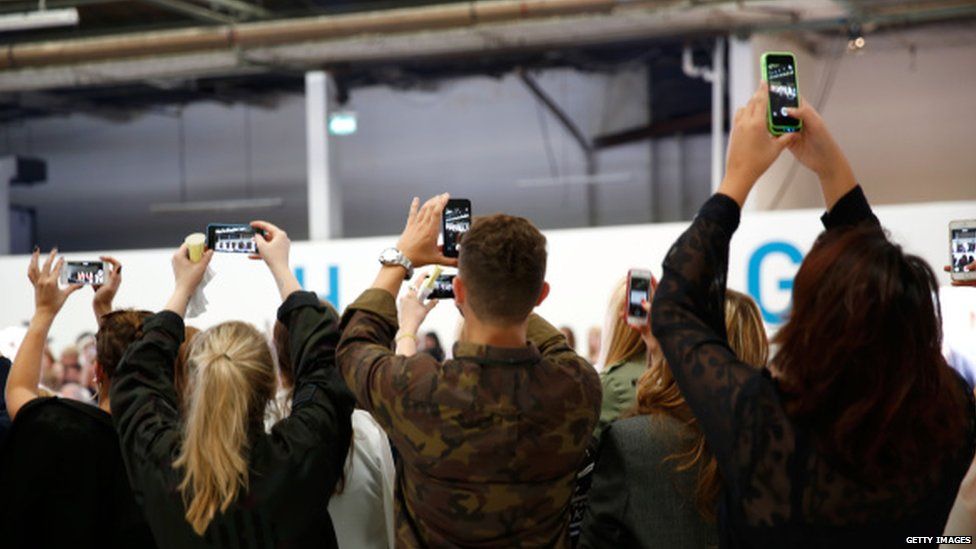
The use of social media by fashion insiders is artificially speeding up the fashion calendar, because customers are seeing fashion instantly as it hits the runway. Josh Newis-Smith, the junior fahion editor for Grazia magazine reckons this obsession with capturing and sharing every earring and handbag on the runway is changing how the fashion industry works. "We're all watching a show through our phone, rather than our eyes," he says. "Social media is now so relentless, you are spending your whole time on Instagram, Snapchat, Twitter, Periscope... Everything needs to be instant." September is the time designers reveal their collections for the following spring and summer.
 Mobile style at London Fashion Week

 A fashion show is not a closed off experience only to be seen by the chosen ones anymore, in the old days, the spring summer collections were seen by customers only in magazines in the following February. This speed up has had a major influence especially on high street brands such as Zara,Topshop or online-only retailer Asos, they have enough resources to create collections inspired by the current fashion month in a matter of weeks and that´s exactly what customers want. By the time designers clothes have got into the stores, the high street has already interpreted their look several ways,it is good for customers, but experts are aware that at some point this pace needs to slow down.


NEW AGE INTERACTION

Instagram fashion accounts with most followers

In the fashion industry, social media platforms can be used to interact with the consumer, as a means of networking with others in the industry, and as a way of building an online presence. But social media can also influence designers in unique ways that are changing the way many designers create their fashions.It’s not just the inspiration and influences on major fashion designers that social media is evolving; it’s also the way we view fashion and the industry as a whole. For decades, a few big names dominated the fashion industry in a very top-down fashion but now social media has acted as a catapult to push the “unknowns” into situations where they can make their designs and ideas known to millions.The Blogger´s effectiveness is due to a strong individual, personal, popular, and elitist point of view. The engaging experience of a blog offers readers the opportunity to voice opinions and challenge fashion critics.Once considered fashion-obsessed amateurs, now brands view popular bloggers as the new journalists, influencers and trendsetters. 
 Social media sites act as a platform for the average person, and major fashion designers know these people are out there so they can also reap benefits by reaching customers on a new level that is more intimate and interactive, rather than the highfalutin fashion runways. A study from eBay Deals shows that more people are using social media for wardrobe advice, inspiration and the latest trends and fashion related Tweets doubled from the same event just a year earlier. From people sharing Instagram photos and Tweets from the sidelines of top fashion runways, people from home can interact and engage in the fashion shows just like the attendees.
Elitism within fashion has been hugely eroded, and this is for the best. The floodgates have been opened to a new generation – young creatives of multifaceted and sometimes-obscure talents that challenge preconceptions and convention.
Most influential fashion bloggers of now


THE EXTENT OF INFLUENCE 
In this new day and age young shoppers are making important decisions online and learning about fashion via blogs rather than via fashion magazines. What follows is a democratisation of opinion, as young fashionistas can connect with people who really matter to them like designers rather than the traditional journalists. Facebook influences shopping habits of teenage the ‘social shopper’ more than any other medium. Even the smarter, clued-in fashionista-types remain heavily influenced by Facebook, with independent blogs providing a only a little bit more influence. However both Pinterest and Instagram are huge players, just behind the aforementioned Facebook and blogs for multiple age categories. For the first time in history,customers are shaping how brands create and portray themselves.