Wednesday, March 28, 2012

New media : replacing the dog's function being your best friend


The human population has to face a new fact. New media has changed the society’s ranking values.
Have you ever thought who is the human’s best friend of 21 of century? 100 years ago this position belonged to a dog. Nowadays the situation has changed. People have started to replace their pets. A pet should have four legs (some exceptions two),it can move without any help, it should have own brain and it usually makes some sound. The pets of 21 century also have own brain and made some sound, but there are naturally made by humans and they consisted of human devices.
According to one study, computer has overtaken the role of dog in the family. If you can notice people take their computers and all the other kinds of new media everywhere with them. If they feel lonely they can do one easy step, log to the social network and the problem is solved. They are very sensitive and squeamish about their computers. They always have to have a special place in the house, in the school, in the car, in their personal bag. Some people can’t survive one day without their loving pet called Computer.
,, According to an online poll of British adults conducted by Computeractive magazine and animal charity RSPCA,  Researchers found that just 6 per cent of us believe that 'most people rely more on their dog than they do on their PC', while 67 per cent think the opposite to be true. Even 38 per cent of dog owners confessed to relying more on their PC than on their dog, although 36 per cent disagreed.“ And 71 per cent of 18 to 24-year-old dog owners said they relied more on their computer.
People, even the ones who owns dog spent more of their time on the computer than with their dog.
Thinking about society right now, this is not that shocking outcome of the research. So what is so special about the PC than our loving best friend doesn’t have?If they don’t see their dog, they miss him but when they don’t have any access to their computer they feel detached from the entire world.

People are getting addictive to the internet. They do everything through the internet.  They find their friends, their husbands and wifes and they prefer to spend their free time surfing on the net than going out with their friends. Instead of writing personal diary people are getting use to write whatever they want into their blogs. Doesn’t matter if the information which they share is valueable or not, they just want to show off in front of their new computer’s friends, which they haven’t even seen live.

Computers have too big influences of our life, nobody can argue with that.
Which function from the dog has computer overtaken?  Their is a statement about computers which says : ,,Without computer you can never get bored.“ Is it really so?
But we should think about one important thing. When our computer stop working and it is dead we can just easily replace it. But when our dog dies we can’t replace him so easily.
Can you think how long have you survived without using your computer or any other kind of new media? Have you been thinking about it a lot or was it easy for you?

LENKA LIPTÁKOVÁ


Saturday, March 24, 2012

Bradbury’s "Fahrenheit 451", a visionary insight of new media evolution


For a minute, let’s imagine you’re back in the 1950s in America, in the early days of mass culture, when new, modern consumer goods were made available for more and more people:  after the success of radio, television's popularity increased rapidly, to such an extent that at the end of the decade, 77% of American households owned a TV set. Media advertising contributed to forge - and sell- the American way of life, and conformity, entertainment, and happiness became key words of the post-war consumer society. 

Inspired (or more precisely, frightened) by these new social trends and technologic developments, science fiction writer Ray Bradbury published a dystopia entitled Fahrenheit 451, in which he delivered a pessimistic vision of where new media could lead society to. In Bradbury’s world, a deluge of trivial information and immediate entertainment has replaced culture, which has disappeared, burnt down by pyromaniac firemen (whose job is no longer to put fires out, but to burn books, which are considered dangerous for society). The main character, Montag, is one of these firemen, who becomes gradually aware of this generalized alienation and starts questioning the system: by preserving books from destruction, hiding them and memorizing their contents to give culture a new life, he engages on the path of transgression and rebellion and becomes an enemy to be chased. Look at this if you want to watch some extracts of François Truffaut's 1966 adaptation of the book ! 
                              
Even though Fahrenheit 451 was published 60 years ago (in 1953, to be precise), this vision of a not so distant future society, where mass media have taken the upper hand over knowledge and thinking, proves to have threateningly relevant aspects in today’s world of proliferate digital media. Regarding television and its evolution, Bradbury’s prediction is still striking us by its technological and psychological accuracy: while the book was written in the era of TV box sets making their first entrance into people’s daily life and providing black and white programs, Fahrenheit 451 depicts a society driven by television-addiction and self-reclusiveness. 
   
TV screens are now entire walls covering and constituting the very rooms which they are put in, creating a new, full digital experience: as epitomized by the character of Montag’s wife, who wants her husband to work more in order to afford the fourth screen-wall which is still missing in their living room, people measure their happiness by the intensity of digital reality they have access to. Difficult not to think of today’s TV screens becoming larger and larger and designed at making digital experience as vivid as possible (look at the advances in 3D technology)… In Fahrenheit 451, communication is no longer unilateral and undifferentiated (two aspects defined by media analyst Marshall McLuhan as main characteristics of mass media), and the viewer can participate directly into the TV program, contributing to create the message:
“What's on this afternoon?" he asked, tiredly.
She didn't look up from the script again. "Well, this is a play comes on the wall-to-wall circuit in ten minutes. They mailed me my part this morning. I sent in some boxtops. They write the script with one part missing. It's a new idea. The homemaker, that's me, is the missing part. When it comes time for the missing lines, they all look at me out of the three walls and I say the lines. Here, for instance, the man says, 'What do you think of this whole idea, Helen?' And he looks at me sitting here center stage, see? And I say, I say--" She paused and ran her finger under a line in the script. "'I think that's fine!' And then they go on with the play until he says, 'Do you agree to that, Helen?' And I say, 'I sure do!' Isn't that fun, Guy?"
Each viewer takes personally part in the show and so it is not difficult to understand that, as a result, this interactivity has completely blurred the frontier between reality and digital world. Social relations have been transformed to such a point that for Montag’s wife, the numerical projections on the screen, which she talks to and lives along with, have become her true family… conversely, she only has a superficial, dull relationship with her husband. If media were invented to connect people, here we can see a total subversion of this original goal ; here we can see the triumph of perpetual entertainment, alienating people’s minds from reality and caging them into an artificial happiness, as Montag tries to explain it to his wife:   
“Let you alone! That’s all very well, but how can I leave myself alone? We need not to be let alone. We need to be really bothered once in a while. How long is it since you were really bothered? About something important, about something real ?”
In the end, this vision of new media developed in the 1950s certainly continues to give us food for thought, at a time when the threat of such a dystopia coming true does not seem as improbable as it used to. Even if books are not yet in such jeopardy as in Fahrenheit 451, the multiplication of numerical books and kindle editions (more convenient to carry etc.) is not without raising questions about the future of printed books and the possible transformation of culture. Just consider all these online digests, often made for students, shortening hundred-page long books into basic summaries, and exempting you to read the whole book to have an idea about it… Ironically enough, while Bradbury has always distrusted dematerialized books and considered they would pave the way for the death of books, Fahrenheit 451 was finally released as an e-book in November, 2011 (with the author's consent) and it is now on sale from all major e-book retailers. The unstoppable march of digital media?

#Loewe's viral experience


March, 14th

“Do u wanna laugh for a while and/or feel embarrassed? Watch the new advertisement of #Loewe” by @pathernando.
“The documentary about special education of #Loewe is great” by @cot_julia.
“All of you hate #Loewe’s new advertisement, but, all of you talk about it. Do you know what viral marketing means?” by @October_Lee.


What does viral marketing mean?

Viral marketing means advertising, it means money, interactivity, and above all it means social networks as means.
Just imagine a virus. A simple flu will serve. Yesterday you went to a hospital and you, unknowingly caught the virus. Later, you went out with your fiends whom you, unintentionally, transmitted the virus. They came back home and transmitted it to their families. Parents went to work and brothers and sisters went to school. We already have an epidemic. All infected.
Now, replace the flu with an advertising message and the hospital with Youtube. The key: to transmit = to share. Like.
This is viral marketing, an advertising strategy that seeks the rapid spread of a message to potential consumers of the advertised product.

Viral marketing is no new. Do you remember mouth-to-ear (word-to-mouth)? These are the roots. Nowadays, mouth have been replaced with “Notification on your wall” and ear with “Share on a friend’s timeline” or #let’screateaWorldwidetrend. Today, the Internet and social networks are the mean and the propagation is quicker and more effective.
A company hides an advertisement within a provocative idea in video format that make viewer’s opinion came up et violá!, for the modest price of a video uploaded to Youtube for free, it got to manage to thousands of people. And everything without paying for spots on TV or radio. Economic ¿right? Yes it is, and much more when traditional media publish pieces of news about the success of the viral campaign. Total media convergence. Just one text, many media.

This is precisely what Loewe, the Spanish firm of luxury goods, has achieved. Let solve the unknown factor. A company: Loewe. A message: gold collection 2012. A provocative idea: try to represent the Spanish youth with a sample of "supercool” young people."The results: #Loewe, Spain trend in Twitter, 730,000 views on YouTube, hundreds of posts on blogs, articles in national newspapers, parodies on YouTube... and most important, thousands of young Spanish people speaking about Loewe, even if it’s only to criticize and satirize. But... how true the idiom 'let them talk, well or bad, but talk' is?

Sunday, March 11, 2012

Kony 2012 - Political Activism in New Media


Have you ever heard of Joseph Kony?

Kony is 49 years old, lives in Uganda and is the leader of the so called Lords Resistance Army (LRA). The aim of this army is to have a theocratic governmental system based on the bible and the Ten Commandments. The pneuma itself gave Kony the order to found this army and conduct this war. His modus operandi is suspect, because the LRA is today known for its brutal abductions of approximately 66.000 children. They became the involuntary soldiers of Kony's army. He is accused to be responsible for the brutal despoilment of entire villages and for the command of murders, rapes and mutilations. All in all he terrorizes the civil population of Uganda, the Central African Republic, the Democratic Republic of Congo and of South Sudan for more than two decades now.

A week ago the American aid group "Invisible Children" (IC) published the "Kony 2012-Campaign" on the internet. It is a 30 minutes film, made by two American filmmakers, who founded the organization IC. Within 48 hours the video had more than seven million views on the platform Vimeo, more than five million views on Youtube and more than one million "likes" on the social network facebook. Even now this campaign is one of the most impressive examples for the change of political activism through social media. The film is viral and very well produced and it has a gripping effect on the viewers. But in the same time the video aroused worldwide criticism. Can a facebook "like" save the world?

In the film you can see the little son of one of the founders of the organization and he learns in front of the camera, what his daddy does and who the bad people are. Furthermore they show an interview with one of the victims, where he describes the atrocious death of his brother. Most of the scenes are supposed to arouse compassion in the viewers and the techniques they used seem to work on the people. But it's not only the self-dramatization which provides critics with a target. In the film they call people up to buy a "Kony-Action Kit", which contains posters, a T-Shirt, Buttons, an Action Guide, Stickers and Kony-Bracelets. To buy this Action-Kit, people have to donate money to the organization on the long term. But it has been proven, that most of the money is used for running costs, promotion and the production of films. Only one third of it is used for development assistance. Further on it is said, that the research behind the film is rather poor. Some of the scenes are more than ten years old and the situation in Uganda has not only changed, it is much more complex than it is described in the campaign. So that academics doubt, that the problem would be solved with the arrest of Joseph Kony.

The Ugandan President Yoweri Museveni already made a statement, which says, that Uganda is not in danger anymore. The people actually live in peace there nowadays and Kony doesn't stay on Ugandan territory any more. He even invited the two founders of Invisible Children to come to his country and see themselves that the situation has settled down. But about this, people should also keep in mind, that Uganda is afraid now, that the tourists are put off, after they saw this movie. After all tourism plays a role in the countries economy and if the people stay off from the country, it harms them. Museveni emphasizes this in the end of his statement, when he refers to Uganda as one of the top must-see travel destinations named by the Lonely Planet this year.

However the aim of the campaign is to make Kony famous and arrest him before the deadline of the 31.12.2012.
Last october the U.S. sent 100 soldiers to Uganda, to help in advisory function on the spot. The film says that without public pressure those troops would be removed by the American government.
However, there are no indications for the withdrawal. So the motivation of the film is also questionable.

Despite all the criticism and the suspect effect on the happenings in Uganda, the film was successful in a way, that it raised worldwide awareness of a problem which shouldn't go down in the massive flow of nowadays media. That reality can't be depicted in a 30 minutes film should be clear in everyone's mind. But to write this campaign off easily and call it emotional blackmailing is not right. Because in the end this movement shows that social media is something which people can use in a much more efficient and intelligent way than creating virtual personalities or following the details of Kim Kardashian's sex life.


Saturday, May 21, 2011

Comic strips and the Internet : a perfect match ?

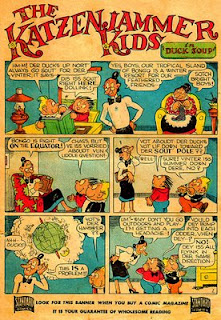
Comic strips are still very popular today. Between the popularity of mangas, the revival of superheroes (their influence has progressed toward T.V., with the T.V. show Heroes for example) and the spread of comic strips on the big screen (Persepolis, by Marjane Satrapi was a great success), comic strips have become a worldwide product. Comic strips in the USA became popular thanks to the press. During the beginning of the 20th century, comic strips were published in the last pages of newspapers. It started out with “Hogan's Alley” by Richard Outcault in 1895, “Katzenjammer Kids” by Rudolph Dirks in 1897 and “Little Nemo in Slumberland” by Winsor McCay in 1905. There has been a real revival of the comic strip genre in the 1990's and since then, comic strips have been declined on different mediums. Comic strip, much like all form of entertainment, can now be found on the internet : they are called webcomics. They suffer, just like the music and film industry, of illegal downloading. Nevertheless, the format of a comic strip is much different from the one of a cd or a film. It seems as though the pleasure taken from reading a comic strip is partly due to the medium itself, to the holding of a nice object. Do comic strips and the internet make a good match ?

Comic strips can now be found and read on the internet. Of course, there is the alternative of downloading them and reading the strips on a computer. This is put on the internet and can be analyzed as contributing to Pierre Levy's concept, collective intelligence. The concept of collective intelligence signifies that the group has more knowledge than the individual, if the information each individual has is put together. Putting comic strips on the internet and giving it free access is a way of sharing information and contributing to Internet’s "brain". Most of these comics published on a website can be found exclusively on the internet. The first webcomic was Witches and Stitches put on the internet in 1985. Internet gives the possibility to anyone to publish their own comic. The genre has become so popular that there are now many user-generated comics site. They are search engines that permit to find a comic strip, depending on the genre, the country and other categories and read them. There is a real work in making accurate metadata, and therefore contributing to a functioning collective intelligence. For example, there is www.drunkduck.com, "the Webcomics Community". Along with hosting for free webcomic creators, it also has a forum which permits interaction between the different fans. This enlarged community helps prevent what Cory Doctorow calls "metacrap". Indeed, the contribution of many on these comic strips portals ensures a certain quality, where the consumer chooses freely and judges honestly. DrunkDuck, in its description, adds :"We offer many free tools and a strong community to not only help a webcomic creator publish their work online, but also to continually learn and grow as an artist. As the quality of the work improves, so will the quantity of the audience.". The user of the internet can become a productor in two ways : by creating a webcomics or by commenting and participating in the comics fan community online and suggesting new ideas to the artist. Webcomics are a clear manifestation of “produsage”. Axel Burns defined this term as a system where consumers are producers as well. This can be possible only in web 2.0. A top-down system between the editors and the readers does not exist anymore with webcomics : the internet gives more freedom to the author, who does not have to please and make concessions for the comics editors, who does not have to impose himself any limits on the choice of themes, subjects and vocabulary. The author is given total artistic freedom. This is very true to the extent that we can find the inversed scheme : confirmed comic strips artists find refuge on the Internet to deliver to its readers more explicit content. On the French website www.bdcul.com (closed down last year), artists can expose their pornographic comic strips without restriction. The author’s only limit is the goal of getting positive reception from the Internet fan community.

Nevertheless, even if comic strips can pull many advantages out of the internet, the ultimate goal remains : to publish the story in a hard format. The medium of the Internet seems to be more a first step toward popularity and artistic reconnaissance. Indeed, webcomics artists are not financially self-sustainable. Furthermore, the importance of the paper object still exists. The internet has only copied the format of comic strips on a screen : The medium of the internet does not bring in itself any interesting change to the content. Therefore, webcomics contribute to collective intelligence, to freedom of the author and of the consumer (who has free and easy access to cultural contents), but the Internet and comics have not found the keys yet to a perfect wedding.

Mélanie Rauscher

Tuesday, May 3, 2011

Media Panics and the Internet

Throughout the centuries ever since a new medium would enter the society, the panic about it would follow. This trend dates back to as far as the Ancient Greek times. One of the most famous philosophers of the time Plato commented on the ability to write in this manner: “If men learn this, it will implant forgetfulness in their souls; they will cease to exercise memory because they rely on that which is written, calling things to remembrance no longer from within themselves, but by means of external marks“. Moreover, the publishing J. W. Goethe’s masterpiece “The Sorrow of Young Werther” resulted in a chain of suicides, as young men in the 18th century found the course of action of the hero of the book worth following (Werther, the main character, killed himself because he loved a girl who loved someone else). These tragic deaths forced the governments all across Europe to ban the book in the 18th century. In later publications, Goethe addresses the reader with the words “Be a man, do not follow my example”. Similarly, there were fears surrounding the 19th century dime novels and dance halls about 100 years ago. There are some more recent examples as well, regarding every single medium one could imagine. Reality TV, explicit music lyrics, movies like Clockwork Orange or Child Play 3, video games – you name it, every one of these had difficulties with entering the scene without causing a heated discussion. These types of societal reactions are called “media panics”. In this post I will try to take a look at media panics that were caused by the internet and its many applications.

But before doing so we have to define what a media panic is. Oddly enough, however different the mediums might look from one another, the panics about them are quite similar. As Danish professor of the field Kirsten Drotner once put it, media panics always happen in the same manner, they have the same cycle. Firstly, the discussion starts, then some sort of governmental or industry self regulation is introduced and finally the panic disappears. This pattern can be applied for all the above mentioned panics. Another similarity is that these fears are always caused by the introduction of a new, unseen media that more often than not are created for the entertainment purposes. Finally, media panics are always about the young users.

Media panics arise from reports about the shocking cases of a possible abuse of new mediums. To make this clearer, let’s take an example of Columbine school shooting. 15 people were killed and 24 were severely injured when two students arrived to the school armed to the teeth. Until this day the general opinions make out that the killers were influenced by a first person shooter video game Doom. Many other factors – such as drugs used by the perpetrators or their acquisition of guns – are left aside. This tragedy was a big hit to the FPS developers’ industry and not to pharmacy or gun industries.

So by now the reader probably understands what is meant by the term “media panic”. Let’s take a look at the internet. Created in the second half of the 20th century it started to become massively used in 1993 with the introduction of the World Wide Web and the internet browsers. The internet firstly was looked at as a perfect field for communication. It was a place for virtual communities to be established, people could experiment with their identity and the possible reach of it was not seen ever before. However, it was not too long until the first panic took place.

“Researchers find sad lonely world in cyberspace” – shouted a press release from the Carnegie Mellon University in Pittsburgh. The quote was immediately caught by the New York Times, CNN, BBC and other press corporations. In the year of 2009 it was used in 1633 academic papers! “The Internet has the potential to make us socially isolated, lonely and depressed”. Well, of course it has! A cat has a potential to kill its owner in his sleep but is it likely that it will do it? It was also found that the internet usage may result in decrease in family and social contacts and that the teenagers are the most vulnerable societal group. It is vital to know that in 2002 the participants of the survey of 1998 (on which the results were based) were revisited and had to answer the same questions. It was found that the aforementioned effects of internet usage are not likely to happen. This second research that denied the results of the first one did not get a press release. Ever.

Current academic consensus on the internet usage stresses out that online communities build on offline communities; online contacts are related to offline contacts; and that family and friend networks are maintained. The internet is seen as reinforcement to strong and weak ties rather than a thing that can make us alienated and lonely. Its importance for dispersed groups (such as migrants or homosexuals) is invaluable.

Rarely a talk about internet and its’ many evil sides can happen without mentioning online predators. In the USA an extremely popular show called “To catch a predator” has been broadcasted on the national television. You can watch an excerpt from it here to see what I mean: http://www.youtube.com/watch?v=dZhsfT9wGp0 . Even though this show seems to be doing a good job of hunting down possible peadophiles and other types of bastards, it usually draws away from facts. It is a proved fact that most of the cases when teenagers meet adults that they met online, they know what they are doing, they know that they were talking to someone who is a lot older. The problem about chatrooms and online predatoring is a bit different thatn adults hiding behind the curtain and pretending to be of the same age as their victims. The real problem is that the teenagers are curious about meeting these people. And again, it‘s not the internet that is to blame for that, is it? According to, for example, UK law (where this problem has been in the spotlight for a long time) cases like that look more like statutory rape ("consensual sexual relations that occur when one participant is below the age required to legally consent to the behavior”) than predatoring.

And finally, we move to our beloved Facebook and friends. In April 2009 several publications were printed in the British newspapers (Daily Mail, The Guardian, and Sunday Telegraph), causing a media panic about social networking sites. “Social network use may alter the brain structure” – said Susan Greenfield: a member of parliament, a professor and a baroness. Moreover, Vincent Nichols, the Archbishop of Westminster said that “Social network sites produce transient relations that can cause trauma and even suicide when they collapse”. I would suggest to focus on the words “may” and “can” in both quotes. It basically is the same argument once again: social networking may make you feel lonely and depressed (like the internet itself in 1998) and can alter your brain structure (like the video game that has been blamed for the Columbine tragedy). Even though this panic is still happening and the cycle is not yet finished, one can try to foresee its finish. There will probably be some industry self regulation (it is already happening with, for example, checking of photos that are uploaded on Facebook. I simply am expecting the wider range of these actions). There will probably be some tragic event that SNSs will be blamed for (actually, one already took place in Lithuania this winter, when a psychologically unstable teenager killed a girl. You can guess where they met each other). And in the end this panic will die out. It always does! Who knows, maybe we’ll hear people talking about the harmful effects of Nintendo WII (“it teaches our kids the robotics of unwanted actions like shooting a gun”), maybe the new iPad will be torn apart. I will conclude by simply putting it this way: the developer of The Next Big Thing, brace yourself and be ready to be under attack. Because you will be.

Monday, May 2, 2011

Did your social life improved or deteriorated with the internet?


The Internet is the last technological breakthroughs in interpersonal communication, following the telegraph, telephone, radio, and television. Social life has been affected by the innovative features provided by the internet which are, among others, the possibility to do everything at distance, to play games in virtual worlds, to communicate with the anonymity afforded to users, and the possibility to join meeting groups in which people have similar interests and values.

Social life has taken a different shape above all with the revolution of the internet communication through mails, meeting sites and social networks such as MySpace, Facebook, LinkedIn.

Social networking on the Internet combines various ways for users to interact, such as text chat, messaging, email, video, voice chat, file sharing, and discussion groups. It is a revolution for the communication and the way to share information with each other. Hundreds of millions of people are using social networking every day, and it now seems that social networking is a part of everyday life for a lot of people, making it a very success.

One of the internet's main objectives is to establish a way to communicate between individuals more or less connected. However the evolution of the Internet has a great impact on the social relations which have changed positively and negatively due to the Web.

“There is a tendency by critics to blame technology first when social change occurs", Keith Hampton, a professor at the Annenberg School, said in a statement for a study released by the University of Pennsylvania's Annenberg School of Communication.

What does the internet communication provoke?

OR
?


On the one hand, the main critic to the internet communication is that it has a tendency to lead to social isolation, simply because the more time you people spend on the internet the less they spend it in the « real life ».

http://www.youtube.com/watch?v=cSkk-t03BOw&NR=1

Although the participation to forums or to emails exchange assumes a social interaction, the big users have the tendency to spend less time with their family or friends. It has been also studied that they spend less time to work, to think, or to make domestic work. They give less importance to the resting time and are more likely to sacrifice their sleeping time.

Indeed, the internet is an attraction to be lazy and to not leave your home to do all the things of daily life. You can shop, date, talk, play, and even have cybersex while staying comfortably at home.

Another negative feature of the internet communication is the anonymity and the impersonal elements which might encourage users with personal taboo or lack of self confidence to live a secret life on the internet and to steep themselves in a virtual world. You can be anyone you wish to be on the internet, even if you are unattractive, shy, unpopular, or have trouble carrying on a conversation with people face to face in real life.

It happens also to some people to be addicted to the internet and this can deeply affect their social life. Internet addiction can lead to withdrawal, feeling angry, tense, or depressed when the Internet is not available, excessive Internet use, resulting in a loss of time, mood swings, including arguments, lying, isolation, fatigue, and poor achievement of goals. The comfort provided by the Internet finally kills their spirit of initiative and their desire to move.

These people, spending the majority of their time in front of a computer, are known as « No-life » or « geek ». There is a rise observed of these “No-life” who become dependent on the internet use until a point where they forget the main rules of hygiene such as eating and washing themselves.

In some most extreme case, online games such as Second Life, World of Warcraft or Habbo who have developed considerably, aim to create a "virtual life" aimed at users who want to adopt a new life characterized by "dream". But these games are not only extremely additives, but also very influential on the behavior of players. Indeed, users often tend to shut themselves in a virtual world and away from the real world, up to risk losing any physical contact with people around them. These Internet users have the characteristic to not realize this and think that they create new social links on the Web. Despite this reality, the Internet may cause a total disconnection between a user and the real world and can thus undermine the creation of social ties.

On the other hand, the use of the internet in social interaction might simply be seen as a provider of better efficiency and opportunities to communicate with each other.

http://www.youtube.com/watch?v=YTfOfIj6uhM&feature=related

Social networks on the internet are very successful because they facilitate a lot of interpersonal interactions not possible in the physical world. People enjoy human interaction and thus enjoy internet tools that facilitate them through discussion, interaction, and sharing of common interests. The use of the internet enables us to be and interact virtually somewhere we are not physically.

Social networks enable people to keep contact and share a piece of their mutual life even if they don’t see each other. It also helps people to have a wider and diverse social circle.

"It turns out that those who use the Internet and mobile phones have notable social advantages," Hampton said. "People use the technology to stay in touch and share information in ways that keep them socially active and connected to their communities."

The internet is also a way to equalize people socially. Indeed people with a smaller social network or a greater social anxiety might be helped by the use of the internet. In this case, the internet is most useful in the initial contact which might not happened in real life because of lack of self confidence or social anxiety. They can meet and get to know other people better through the net, and when they feel more comfortable and intimate with the person and the relationship they created “virtually”, they can meet in the real life and then bring this relationship into a traditional face-to-face relation. The internet is not a threat for the social contact in the real life as long as the people use it as a tool to improve them.

"People's social worlds are enhanced by new communication technologies. It is a mistake to believe that Internet use and mobile phones plunge people into a spiral of isolation", Keith Hampton says, a professor at the Annenberg school.

As a conclusion, we can say that the impact of the internet on social life is not clear.

http://www.youtube.com/watch?v=sw-saZ95OgY&feature=related

Internet is initially supposed to help us improve our relationships in real life and not deteriorated them. Unfortunately the use of the internet may reach some extreme case where the user become dependent or addicted to the net but it is then the user’s responsibility only. The threat of social isolation due to the internet is dependent on the character of the person.

Because nothing can replace the contacts in the real life and people need interaction with each other, they must be able to get away from their computer to have a healthy, happy, and productive life. So, as long as we don’t forget that, the internet should help us to improve our relationships.

Sources

http://www.medrounds.org/ophthalmology-pearls/2010/02/whats-buzz-about-social-networks.html

http://www.internetnews.com/bus-news/article.php/3847041/Does-the-Internet-Really-Wreck-Your-Social-Life.htm

http://faculty.washington.edu/thurlow/com482/tyler(2002).pdf