When I first heard of Pinterest, someone was referring to it as "Google images for girls."
It took awhile for me to jump on the bandwagon, but when I did, the appeal was instantly apparent.
It also became apparent that "Google images for girls" was an inadequate description.
Pinterest, in essence, is a visual discovery tool.
Users explore and organize various interests by saving "pins" to "boards."
Pins are images. Many are linked to websites where you can find more information pertaining to the picture.
Some don't link to anything, and others are simple, user-generated j-pegs.
Boards are categories in which users save related pins.
These categories can have wide scopes ("Truth") or specific purposes ("Wedding Ideas").
Users can also choose to "follow" friends and strangers alike, giving them access to other users' pins.
Below, you can watch a short video of how it works.
Pinterest gives users an aesthetically-rewarding way to learn more about their interests or perhaps find new ones.
For example, the majority of food-related pins are linked to websites where the recipe is written.
When pinning a picture of lemon poppyseed pancakes, a user has the option of annotating the pin.
That is, he or she can write a short blurb about how wonderful or awful the recipe was.
The numerous and varied nature of the web sources that Pinterest is built on is in itself a foundation for collective intelligence.
When you add in a touch of social networking and annotating capabilities, you have a buzz of information sharing.
Obviously, it is not possible for any one person to learn everything.
However, with this platform, a user can learn from multiple sources in one scrolling session, and the wealth and richness of those sources is made possible by the input of many other users.
The sum contribution of multiple users creates a compilation of knowledge much greater than that of an individual user: thus, the very definition of collective intelligence.
Pinterest has already become a popular way of gathering inspiration and information in the process of planning anything from hiking trips to weddings.
Collective intelligence via easily consumable bytes provides Pinterest with a plethora of possibilities.
The Internet is a vast horizon of information.
Pinterest gives people a way of broadening it pin by pin.
Well
Forgotten Old
Only sixty
years ago when our grandparents were young media was mostly the tool for
getting news. People did not have immediate connection with each other: they
just walked, wrote letters, in emergency used telegraph, read books and
magazines, listen to radio and vinyl records, collective intelligence was rare
and had different forms. Is it all gone?
Letters
Letters
appeared when people invented writing. Initially they were more like our
stickers “Don’t forget something”. With development of writing letters become important
source of getting news, most important (for example, from imperator to nation)
were read out loud on main squares of cities. Invention of radio substituted
such kind of letters, invention of phone and internet substituted other kind of
letters. However, more than 1300 localities with 500-10000 people in Russia
still don’t have mobile and Internet connections. They have to write letters or
travel to exchange opinions with friends.
In the
second half of the 20th century sending letters with opinions or
complains to magazines was very popular. Some people still do it, but the
majority of letters have an informative, business nature. With popularization
of the Internet people stop writing letters, and now they have more intimate
character. To get a paper letter from your friend is something very unusual, surprising,
and pleasant. I’ve got only two letters in my life, and the last one was
several months ago.
Letters
stop have its role in collective intelligence, sharing news with a public, but
get new, more intimate and less media status.
Telegraph
Although
the first telegraph was invented in the second half of the 18th
century, it started to be widely used only by the end of the 19th
century. It works faster than delivery of letters, but wasn’t cheap. Thus,
people used it much rarer than the phone now. If e-mail is development of paper
letters, than from the users’ point of view I think that answering machine is
kind of successor of telegraph. It also gets sound messages (for telegraph
message people usually dictated the text to the worker who then sent it).
Answering machines are not really widespread in Russia, but if old people want
to leave a message (for people who live in a different city), they go to post
office and use telegraph.
Books and Periodic
Reading is
one of the most important parts of education and personal development. People evolve
and books with them. Old massive books transform to smaller lightweight, and
then in electronic books where you can have several books in one device.
Magazines changed with books. Electronic versions of books and magazines win
competition, but paper copies heatedly fight for a place on readers’
bookshelves. While children aren’t used to use electronics for reading,
publishers print lots of children books. It is one of the most important
targets for them. Magazines in Russia offer readers not only paper materials,
but also some gifts. Magazines like “make your collection” use TV advertisement
the most. For example, this magazine offers you to collect minerals, semiprecious stones.
Paper materials are not going to disappear.
Radio and recorders
Music also
moves to the Internet, even radio. In previous century people bought records
and device for playing it: gramophones, tape recorder, cassette player, CD
player, MP3 player. Now they can buy it in the Internet and play on their
computers. Moreover, property rights are quite invalid in Russia, so it is
possible to freely download almost all you want.
In
Vkontakte, Russian network, you can find even apps such as radio of Moscow Institution
of Physics and Technology. Many people listen to radio in their cars, so it is
still popular media instrument. I remember ten years ago radio was alarm clock
for me: I woke up when translation started, near 7am.
My grandmother, despite
she has TV, still use it for getting news. To be honest, only in the kitchen when
she cooks where she does not have TV.
Our
grandparents are going to save old technologies and make them popular in next
generations who’ve never seen them. I believe that, maybe, next fifty years
clubs will appear which will use old technologies.
On www.youtube.com you can
hear a then four-year-old boy called “Oliver” tell how his grandfather
among other things sexually abuses him.
By going onto
www.facebook.com
you can join a group by the name “Help Oliver NOW!!” if
you believe he is telling the truth and you want to support him. On
www.skrivunder.net
you can use your signature to try and make a difference that way. On
www.caremaker.dk
you can donate money to help the cause.
The sound files with
“Oliver” have been listened to by more than 20 000 people and the
Facebook group has more than 7000 members. Around 4000 signatures
have been collected as well as around 28 000 CZK.
It is “Oliver”'s mom
who has the custody over “Oliver”. It is the child's father Kim
Buch-Madsen who has recorded his son on tape. It is also him who started suspecting that “Oliver” is being abused and he has been the main
force behind the cause. Kim Buch-Madsen criticizes the authorities
and says that their case work has not been good enough.
When Henry Jenkins focuses
on shared problem-solving in an online community, he writes that collective intelligence refers to an “ability of virtual communities to
leverage the combined expertise of their members. What we cannot know
or do on our own, we may now be able to do collectively” (source:
Henry Jenkins: Convergence Culture: Where Old and New Media
Collide, p. 27).
In this case the most
active people have divided themselves into groups. The different
platforms have then been used to for example get in contact with
social workers, teachers and policemen. The strategy is to use their
assessments to strengthen the cause, to inform the group's
followers and to get in contact with and/or influence politicians and
different media.
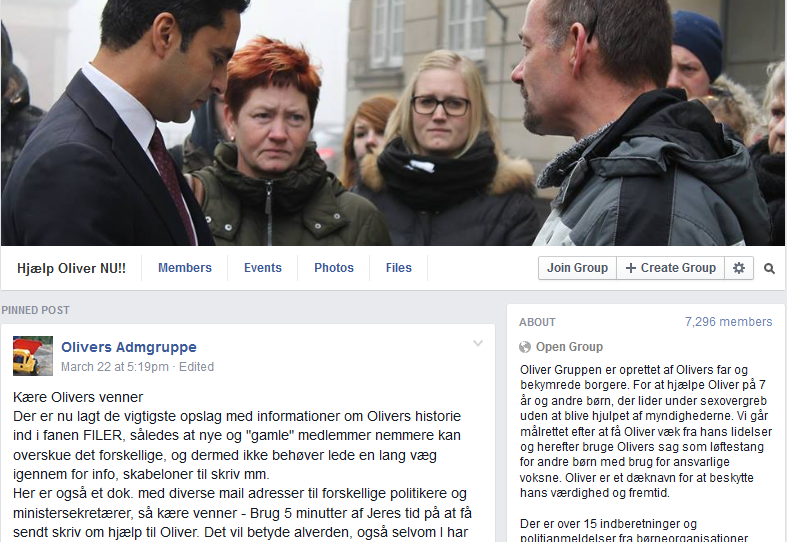
Hjælp Oliver NU!! on Facebook. It is Kim Buch-Madsen on the right and Manu Sareen, the Danish social minister, on the left (photo: Facebook).
Kim Buch-Madsen has
been able to tell his
version of the story several times in
traditional media. For example multiple
times in BT:
1,
2 and
3
and in a program at the radio
stationRadio24syv
The authorities and the police disagree with Kim Buch-Madsen.
According to them there is no signs that
the boy is unhappy, no prove that he has been abused and therefore no
reason to remove him from his mother.
The local authorities have set
it as a target not to
let the accusations stand unchallenged. Some
of the arguments
have been that
the community's
actions are hurting a little boy and
other people they - the members of the community - have
never met or spoken to, and that “Oliver” has
told the police
that he made the accusations to make his
father happy(source:
http://journalisten.dk/pest-og-kolera).
The local authority - Gladsaxe Kommune - answering Kim-Buch Madsen on Facebook. They write that "Oliver" is doing fine, but that he is starting to think more about the situation as he grows older (photo: Facebook).
Another community that
is active in order to change
something they find
unjustis
“Klemte Borgere” and the campaign
“Sygt Valg iAalborg” (it
can be translated into Sick/Wrong/Boring
Election or Choice in Aalborg).
According to them their
municipality - Aalborg - violates
legal rights for sick citizens who have
lost the ability to work. The community was
especially
visible during the local election in Denmark in November 2013 and
theirSygt
Valg-Facebook page is
continuing to be
active. Their
aim is to share
knowledge, cases, experiences and skills to
put their cause
in focus, hold
the municipality responsible and get
them to change.
The main communities are https://www.facebook.com/sygtvalg
and http://www.sygtvalg.dk/.
By the use of for example case stories on the homepage, handing out
very direct materials, commentaries, a manifest and demonstrations
they have managed to get several politicians to react.
More traditional media focused on their cause several times and in
that way they have influenced the agenda.
Material from Klemte Borgere. "Vote again for the alderman if you are healthy enough", it says (photo: www.sygtvalg.dk).
“Klemte Borgere” was -
perhaps not surprising - criticized by several politicians, but the
man, who worked as a journalist as well as being responsible for the
groups way of communicating, won a journalistic award for his
efforts. After receiving the award he expressed how insecure he had
felt making a campaign while working as a journalist at the same
time. He added that it would have felt more right to win it for
traditional journalism (source:
http://journalisten.dk/vinder-journalistpris-politisk-aktivisme).
Although both “Hjælp
Oliver NU!!” and “Klemte Borgere” would probably always wish
they had been more successful, it is two examples of the quite
powerful possibilities of influencing agendas that journalists or
other people - the people formerly known as the audience - have
today.
Old consumers/new
producers use the possibilities to break into more traditional media,
make people active in the process and see how their content
spread (relatively) fast from page to page from media to media.
It is
changing the old rules/borders for activists, authorities,
journalists “on both sides” and for all the people around them. A
lot of things are happening today that would have been hard to
imagine just a few years ago, and the current development can be both
good or bad.
The ideal journalist's (or
the idea of his or her) role - the objective journalist who
“filtrates” information and chooses between right or wrong -
has certainly been weakened. Such a filter does not exist in the
same way. Instead people who are no longer just an audience act. That
can be a good thing, but things perceived as progress are sometimes overestimated.
The old social communities
are breaking down, says Pierre Lévy, and he believes that there will
emerge a new sort of political power and “sees ... knowledge
communities as central to the task of restoring democratic
citizenship” (source: Henry
Jenkins: Convergence Culture: Where Old and New Media
Collide, p. 29). He calls his model of collective intelligence an
“achievable utopia” (source: Henry
Jenkins: Convergence Culture: Where Old and New Media
Collide, p. 29).
But although the changes
are not complete, people are likely to use new tools or
opportunities in many different ways - and access to internet
communities or the possibility for a former audience to no longer be
an audience does not in itself guarantee better communication or more
equality amongst people. It does not prevent 10 000 from being just
as wrong as 10 people. Neither does it necessarily make life more
simple or people more intelligent or well behaved. Perhaps the
outcome will be the opposite.
During the last decade, stimulating achievements in technology and new forms of communication have brought an unprecedented development to the ground of artistic creation. Regarding the design and promotion of entertainment products (films, books, video games,...), the verdict seems clear: the traditional narratives have become obsolete. Just as the different channels of distribution have experienced a deep diversification over the years, the way in which the content is presented has also suffered strong changes. New narratives and platforms seek to involve the public in virtually infinite stories, which are constantly enriched by many different ramifications. The outputs are getting more complex, the fields are broader and the future still boundless, but the concept is nothing new: we are talking about "transmedia storytelling".
The idea was developed by Henry Jenkins, Provost Professor of Communication, Journalism, and Cinematic Arts and one of the major scholars regarding the field of Convergence Culture. Jenkins introduced the term on his essay “Searching for the Origami Unicorn” (Henry Jenkins: Convergence Culture, pp.93-108), defining the transmedia storytelling as a process where the integral elements of a fiction are systematically dispersed across multiple delivery channels, in order to create an unified and coordinated entertainment experience. Thus, each medium has its own unique contribution to the development of the story.
Beyond the creation of complex artistic universes, the transmedia narrative opens the door for huge opportunities of promotion. From viral marketing campaigns, spread through several different platforms, to the total involvement of interested audiences, which become the actual promoters of these projects. Furthermore, since different extensions of the same story are placed in clearly distinct media, this can attract greater types of public, filling different segments of the market. All these benefits have been explored by the entertainment industry all around the world, which finds in Transmedia Storytelling a new creative horizon and a profitable model of business.
Experts on the subject maintain that one of the pioneering experiences regarding Transmedia narrative was "The Matrix", by the Wachowski brothers. It all started in 1999, with a successful movie that brilliantly set up a specific universe of references and innovations. Soon after, this "cosmos" kept on growing with subsequent films, comics and numerous video games. Throughout this prolific landscape, and contrary to what skeptics might think, viewers did not attend a constant repetition of the same themes and plot, but these were increased with new characters, situations and storylines. The inquisitive viewer could not acquire a complete understanding of the narrative by just watching a movie, therefore, he must delve into the multiplying ramifications of the universe.
What at that time seemed strange and eccentric is nowadays a consummated reality. We can talk about several examples of Transmedia storytelling all across the globe (from modest independent movies to the biggest commercial franchises). Although most of these projects still limited to the American media landscape, it is not difficult to find some remarkable cases overseas. Here in Europe, the Spanish precedent stands vividly among others, not only because of the structural innovation of its projects, but also regarding their original strategies of production (through collective financing and participatory creation). Among several examples, there is one case we must highlight:
The Cosmonaut (El cosmonauta)
It is the biggest and most successful transmedia project produced in Spain, an audacious science-fiction movie directed by Nicolas Alcala and released in 2013.
The story is set in the Soviet Union, during the turbulent years of the space race. It begins in 1967, when a couple of young friends, Stas & Andrei, start their training as cosmonauts. During the process, they will be involved in dangerous political intrigues, power struggles and some of the biggest technological achievements of the 20th Century. They will also meet Yulia, a telecommunications engineer with whom they will establish a deep friendship, always teetering on the verge of love.
“A film made by more than 5000 people”.
"The Cosmonaut" is a notable piece of work, not only because of its approach and narrative, but also for its innovative funding plan, new business model and use of Creative Commons license in its production. It has been one of the most successful projects in the world in the use of CROWDFUNDING, having raised €400.000 from over 4,500 people who have made small and medium sized donations to make the film. The production was completed through private sponsorship, merchandising and pre sales distribution, accomplishing what was initially designed as a three/stage plan.
After a year of promotion, the "The Cosmonaut" received a lot of attention from the biggest Spanish media. There were several reports about the film in various television channels across the country, as well as in different newspapers, magazines and radio stations. However, the main coverage of the project came mainly through the Internet. A great amount of blogs and websites based on new media content published promotional articles on the movie. It is also important to mention that most of this mediatic attention was generated after a two-day music festival called "CosmoNauts". It was organized as a mass event to promote the film: nine popular bands of the Spanish indie panorama played in front of an audience that, according to the organization, reached the 400 people between both days. The emerging filmmaker Nacho Vigalondo was thehost of the ceremony, and the event was held in one of the most popular concert halls of the country. Although it was a mild economic failure, the organizers connect the subsequent promotional success of the movie (and its ulterior peak of sales in the online store) to the interest aroused by the festival.
In the same way, the movie distribution model was also innovative. It was simultaneously released in different platforms, in order to allow every user to choose the format they prefer, and each of them adopted distinct particularities: For instance, the release on the Internet still today totally free and in HD, while the TV distribution will have an alternative ending for each channel. A special presentation in cinemas was also designed to encourage people to go to the theaters. This was called “The Cosmonaut Experience”, and it merged elements of performance and recreation with active interaction of the audience. It is also planned to make a series of webisodes, mobile content, or even an ARG, among others. Each series of content will show its own perspective of the story, enriching the transmedia experience.
References:
-Searching for the Origami Unicorn. The Matrix and Transmedia , by Henry Jenkins (Article here)
I consider myself
very much a boring internet user. I don’t claim to be familiar or ‘down with
the lingo’ that is associated with the high-tech and ever changing world of the
web. However, I would like to claim the title of being social media savvy.
Facebook, Twitter, Pinterest and Instagram; I've dabbled. They are excellent
for passing time, staying connected or even self-promotion, but the one thing
that I find ever so bothersome is the bombardment of so called ‘personalised’
adverts plastered on my Facebook homepage. During the inevitable un-tagging of
the weekend’s unfortunate and somewhat unflattering pictures (pictures clearly
sponsored by Czech beer) is it really necessary or even relevant for the latest
health cereal advert to frame the side of my screen. A healthy cereal which is
only considered of interest to me as I once in a rare moment of health
consciousness ‘liked’ a page related to fitness. Personally, I’ve never once
viewed one of these adverts and thought to myself, “Yes! Finally the product
I’ve longed for! How did they know!”, so I find myself asking are these adverts
affective or even accurately personalised? Or are they in fact an annoying
inaccurate waste of time?
For some time now
Facebook has allowed advertisers to target users with personalised adverts. The
personal aspect being derived from the information given out by the user
themselves. On the surface this phenomenon seems like an excellent opportunity
for the savvy business; particularly as they no longer have to waste time money
or effort in promoting their products where there is little interest to start
with. Through the power of social media they can now contact and interact
directly with those who according to computer algorithms or coding are likely
to have an interest in said product. This however, is precisely where the flaw
with advertising on Facebook lies. It is well documented that most people do
not provide detailed personal information; if any at all. For instance, many
users seek to keep their relationship status private and therefore do not
display it all over Facebook; after all why is it anybody’s business? By not
filling in the relationship status Facebook will automatically assume its users
are single and thus need a dating website. Hence the adverts at the right of
your homepage. Thanks for the help Facebook but we will find our own dates.
Moreover, if you do not list where you are employed; hey presto the adverts for
job seeking websites are there. Understandably, this may be useful and in some
circumstances accurate; but this is not guaranteed.
Furthermore, for
the aspirational internet user or in many cases the ‘hard up student’ visiting
a website to view that pair of shoes or that holiday destination that you've long for is a common past time. Facebook will become aware that you have shown
interest in these products and attack you with images of these desired items at
the side of your page. Although, for some this reminder of what you want but
cannot have may be a tool of inspiration, a driving force to get that job, or
get that degree. Nevertheless, for me it is a cruel taunt, Facebook is a cruel
master laughing at me, knowing that those boots will never be mine! However,
let us face it, in moments of weakness we will sub come, worn down by the
constant reminder posed by these adverts and buy those metaphorical boots. In
this case undeniably personalised adverts on Facebook have succeeded in what
they set out to do; getting us to part with our sparse student loans or hard
earned cash.
I admit that my
annoyance with these adverts is simply that; just an annoyance. I am aware that
this blog post could just be considered a rant about what I find oh so irksome,
but aren’t most blogs just one person’s opinions about the world? Unfortunately
with the introduction of ‘promoted tweets’ on Twitter my annoyance is here for
the long stay and is unlikely to ebb.
Facebook is a social networking site
founded by Mark Zuckerberg in 2004 which was originally aimed at university students
now however it is used by masses of people all over the globe ranging from all
ages, genders and classes. It provides the ability and opportunity to connect
with anyone worldwide. As of March 2013 there were 1,100,000,000 Facebook users
and 3.44 users added per second providing fresh meat for advertising companies
to target. When joining Facebook you have to build a profile which involves
giving your personal details such as age, gender, martial status, where you
live etc. etc. smartly they also engage you to share your favourite music,
TV series, sports, jobs and education. This all has an underlying reason its
not just so your friends can check out what you like surely they know that
already! It’s for direct efficient and effective advertising purposes. Its like
taking candy from a baby. Most of us are probably guilty of not being fully
aware of this when we first joined Facebook, I joined like 5 years ago and did
not consider it. I started to realize that if I were searching for example clothes from Topshop online, boom the next time I went on Facebook on the right hand
side would be links and advertisement about Topshop like latest deals and
promotions. Or when I was booking a holiday, loads of holiday companies would
appear on my news feed. The ads began to really bug me because even if I was
just searching a random thing, it would appear on my Facebook. My friend told
me about an Ad Blocker software that you can download which prevents any advertisements
on any website that you access. I use ad block and love it!
However this is definitely a problem for
Facebook as 92% of their revenue comes from advertisements, they have
acknowledged that users are enabling this add on. In 2012 Sara Smith who was
Facebook’s online sales operations manager reported that the cause of Facebook's low CTR (click transfer rate) has been ‘attributed
to younger users enabling ad blocking software and their adeptness at ignoring
advertising messages, as well as the site's primary purpose being social
communication rather than content viewing’. So what does the future hold for
Facebook? Is it still going to thrive on advertising or are they going to have
to verge towards an alternative way of gaining revenue.
To begin with Facebook success was due to advertising as it provided potential advertisers with groups of people to
target specifically due to the information users have provided. They were able
to promote very successful advertising therefore had constant surge of revenue.
However with users becoming aware of ad blocking software the success rate of
advertising on Facebook is dropping. However companies and brands can develop
‘pages’ on Facebook in which users can ‘like’ allowing them to keep updated
regularly with that particular company/brand e.g. Nike. This keeps advertising
fresh as often these companies/brands release competitions online involving you
to ‘like’ and share it on Facebook. Therefore spreading and building the
companies awareness, although how long will this phenomenon last before users
get fed up with advertising being splattered across their newsfeed. It has been
released this week that Facebook are in the process of introducing a electronic
savings and payment services in a bid to boost its appeal in emerging economies
e.g. India and Africa. Check out this link http://www.dailymail.co.uk/sciencetech/article-2604159/Would-bank-Facebook-Social-network-rumoured-planning-electronic-money-services.html.
In my opinion Facebook is an intended
social networking site that has turned into an advertising frenzy.
The selfie
is a self-portrait photo that is quite widespread in social networks today.
The history of this type of photography is much longer than one may expect.
The first
photo that can be called a selfie was taken by an American pioneer in
photography Robert Cornelius in 1839.
With the
popularization of photo cameras in 1900s more and more people started taking
pictures of themselves in the mirror. Of course, these were usually wealthy
people.
With the social networks,
particularly MySpace, rising popularity, people started to post their selfies as profile pictures.
Those were with the use of flash, in a bad quality and usually taken through the
bathroom mirror. Later, with Facebook becoming more popular, those selfies became to be called “MySpace pics”, were considered unprofessional, and were
just a sign of a bad taste.
That could be the death of the selfie. However, it is back.
In 2010s
selfie suddenly started to gain popularity again. Celebrities and politicians started to take selfies of themselves.
David Oriz (professional baseball player) and Barack Obama taking a selfie
In 2013 the
word “selfie” was added to the Oxford English Dictionary and was announced as
“The Word of the Year”. And in March 2014 the host of the Academy Award took a selfie of herself with
many Hollywood celebrities at once. This
selfie outraced Barack Obama’s winning 2012 elections' tweet with 4 times more retweets and became a
new leader in the number of retweets.
Why do
people take selfies and why have they started to do it again after the period
of the selfie being unfashionable?
Experts say
different things. When it has just begun, it was an interesting experience. You
could take lots of shots, see how you look from different angles without any
shame in front of the photographer. Later, with social networks becoming popular, everyone
needed a photo, and the easiest way was to take a selfie, as most of other older photos were probably not digital, but on the film.
But what
about now? When the world of photography became much more accessible, so that
you can buy a professional photo camera or rent a studio for a professional
photographer to make a whole photosession of you? The easiest explanation is that selfies are
for those people who do not like how other people take photos of them. When taking a
selfie, you are making a composition by yourself, catching the best smile, doing as
many shots as you want and in the most attractive pose. What is more, selfie is
considered less glamorous, without pretending you are a model, just humble and
easy.
However, some people may disagree and say that it is more a vanity act, boasting your life
in front of the others, catching the best look to make your friends
jealous.
And finally, some people claim that
a selfie is way of self-expression, trying to share the extraordinary
atmosphere they are now. They say a selfie has become an analogue to an instant
message, telling friends where you are, what you do and
how you feel much beter and faster.
All these
thoughts may be true.
And the
world around us seems to become more and more selfie-friendly. Mobile phone
producers are constantly improving the quality of their front cameras, giving us an
opportunity to take better selfies. No one will consider you weird, if they see
you out on the street taking a selfie in front of the Coliseum.
Companies are even starting to produce special machines to make taking
selfies easier! iStrategyLabs recently introduced their S.E.L.F.I.E. (“The Self
Enhancing Live Feed Image Engine”) that enables you to take selfies hands-free
with the use of a special mirror.
Also, more and more people may be seen with GoPro cameras on sticks taking
selfie-videos and photos of themselves. As the GoPro is made specifically for using in extreme locations,
the selfie phenomenon now has traveled to all the most beautiful and unique places in the world: mountaints, forests, underwater, historical places and
winter Olympics.
Lots of people in world do it. And even a monkey stole a GoPro camera, ran to the forest and shot a selfie video of itself.
Making this
long way through the centuries, selfie changed its roles in different
times. And today it came back in a completely new form. With technologies becomeing advanced and accessible we can take a camera to more and more unique places, sharing our experience. Sefie is becoming our way to express ourselves, telling the world how deep you can dive and how high you can climb.
With the life becoming so fast, when
there is only one special moment that you can catch, why not make a selfie and
tie your life, your experience, your history to that moment? Selfie is back,
and it’s beautiful.


.png)
.png)


