Showing posts with label Facebook. Show all posts

Sunday, November 20, 2016

When Facebook could become a threat when you're looking for a job


          Do you have a Facebook account ? Are you looking for a job or an internship ? Or will you do it soon ? If your answer is yes for each question, you have to know that 7 out of 10 recruiters wil check your Facebook account and its content before to decide if it would be a good idea to hire you or not. So be careful about all the things shared by you or about you. It would be pitty to loose the opportunity of your life because of a photo of you drunk at your best-friend’s birthday.


To be clear, if I’m talking about the relationship between the recruitment and the social networks, you would probably think about Linkedin, the most important professional social network bought by Microsoft for 26 billion dollars. And you would be right because Linkedin is now a real tool in the working life of more and more people. But if we want to simplify Linkedin is more useful to find a candidate, the right profil thanks to millions of available resume. On the contrary, a recruiter can use Facebook to have extra informations and know who you really seem to be when you leave your office.


You never have to forget that Facebook is an open network, and often your name is the only thing that someone needs to know to find your account. You are potentially connected with each person who is able to go on the Internet. I don’t talk about some kinds of hackers or spies, but only persons like you and me with a computer and a keyboard. Your possible future boss is unfortunately for you one of them. And when you are using Facebook, you can’t hide to them all things you are sharing or reacting about, but you can at least try to narrow the risk to be penalized by what you did on this social network. 


On Facebook it’s really tempting to give an opinion or to share something. It seems that you are only with your « friends », and that you say will stay where it is without be used in the future. If you are lucky, maybe it would be the case, it’s better to act before the problem than after, so there some easy things to do. To start, the most important is to take care the confidentiality of the content of your account. It’s always better, when you are looking for a job, to choose for each subject the most efficient confidentiality, the one who allows to share your account’s content only with your friends. With this choice it would be really more difficult for a person from outside your own network to find too embarrassing things about you. And about your friends, the only ones who are able too see the biggest part of your activity, you have to think about sort the list and manage efficiently your requests.


Congratulations, your account seems already more safety. Now you have to take care about the visible part of this account. The part that everybody can see in few clics : Your profile picture and your last cover pictures. It’s not compulsory to have a real professional picture, don’t worry, but please, try to avoid your party’s pictures, your too « funny » pictures (we don’t have all the same humor), or all other kinds of pictures who present you like a person non really serious. I know, it’s possible to be really serious at work even if it’s not the case after it, but between two candidates with a similar curriculum, if one of them doesn’t seem serious in private, it seems unlikely that the recruiter would accept to take the risk to hire him. And be careful of older pictures who could stay available because of your old confidentiality Policy. And don’t forget to check the comments for each available pictures, yours and the ones of your friends. Avoid bad talking and spelling mistakes. Then you can check the design of the visible part of your account going on your profil without be connected to be sure that all is ok.


Your content seems enough protected now, but since the beginning of this article, I talk only about basic things, lots of people already know that, maybe your profile was already protect like this and you didn’t learn nothing. But now I’d like to talk about your activity on Facebook outside of your own profil or the profil of your friends. I’d like to talk about all your reactions you did about différents Facebook pages. Actually, as I said before, Facebook is an open network, and this pages could become a kind of link between you and all the users. And this connection is often an incentive to react about a content. On this network, everybody can give an opinion, can debate with people all other the world, and for this no diploma or certification is needed, everybody can participate. It’s a big maybe the main strength of this network. This flew of opinions allows to change our way to seek information, that information can always be challenging by numerous points of view and somebody who knows something about a subject can share what he knows. You just have to be careful when you are this one, because what you say can be found easily. Just try for example to go on Google, and search « your name + your surname + comment ». You probably will see links to several of your comments you posted on publications of famous Facebook page or others page you « liked ». So, when you do a debate in the comments of a page’s publication, just remember that all the things you said could be seen by people who want to know more about you. Just be careful of your opinions shared on Facebook who could be a problem.

To conclude, I said to you some tricks to protect your content from people you want to know more information about your private life, like a future recruiter. But if you only decide to manage the confidentiality of your profile, maybe it wouldn’t be enough, there is a link between the private life and the rest of the world, this link is the social networks, and you don’t have to underestimate the size of this link. I told about a job search period, but it’s only an example I used to show you how easy it is to have information about you.

Learn To Speak A Different Language! A Short Story About Facebook And Journalism


Many people will have seen this quote, attributed to a 1998 interview with Donald Trump in People Magazine, in their Facebook news feed. It's a great quote, but he never said it. It typifies the kind of fake news and misinformation that has plagued the 2016 election on an unprecedented scale. It's not surprising that the Oxford Dictionary has named "post-truth" its international word of the year, which it defines as an adjective...
"...relating to or denoting circumstances in which objective facts are less influential in shaping public opinion than appeals to emotion and personal belief."
The deliberate making up of news stories to fool or entertain is nothing new. And there is fake news in mainstream media, too. But the arrival of social media has meant real and fictional stories are now presented in such a similar way that it can sometimes be difficult to tell the two apart.


We have always relied on many kinds of sources for our political news and information. Family, friends, news organizations, politicans certainly predate the internet. But whereas those are sources of information, social media provides the structure for political conversation. When Jenkins considered new media "to have the potential to extend civic participation, and to create new forms of deliberative democracy" in 2006, he probably would not have thought that ten years later president Obama warns that the ease with which people can promulgate fraudulent news stories on Facebook threatens basic democtratic principles.

The company is being accused of abdicating its responsibility to clamp down on fake news stories and counter the echo chamber that defined the US election. But is Facebook to blame for electing Trump? No. Is Facebook clear of responsibility? No. Are media free of responsibilty for what happens on Facebook? No. Can they cure the situation? No. Can they improve the situation? Yes.

What journalists can do

CUNY J-school professor Jeff Jarvis said it loud and clear:
"We [in media] should be going to the social platforms, speaking the language there, respecting their context, and using the devices they provide - memes, video, photos, dancing GIFs if that's what it takes - to bring journalistic value to the conversations that now occur without us."


As a journalist who gathered most of my news experience by working in social media I couldn't agree more. I don't want to set up Facebook or Google as the censors of the world. I don't want them to decide what is real and fake, true and false. I rather work on Facebook or Twitter not to promote my own damned stories but to find what people are curious, wrong, and confused about and to bring them journalism. I want to strengthen fact-checking, context, explanation, education, reporting, watch-dogging. Journalism should inform and empower the users, the citizens, the public to share smarter, more factual, more rational and reasonable information. They won't win all the wars but they will win some fact battles if only someone enable them.

Fact Check: Asylum Procedure in Austria

What Facebook can do

Facebook is not blameless. In the opinion of Jarvis, Facebook, too, has a problem. It can do much better to improve what people read and share - "to create not just a better experience but a better society." He states that Facebook has the means to show related content and with that it can show related fact-checking and debunking from reliable media sources. Imagine if, as you get ready to share a meme, Facebook says: "Hey, here's something you might want to see from a news organization showing this is not true." To make this happen, he suggests that Facebook hires an editor not to create content, and not just to do delas but to bring sense of public responsibility; to explain journalism to Facebook and Facebook to journalism.

So with the fake news floodgates now wide open, has the battle to contain it already been lost? No. There will always been fake news, lies, and politicans and they will all go together. Will Facebook's role in the news disappear? Unlikely. It's undeniable that Facebook is a massive source of news consumption, and according to a study by the Pew Research Center, it's only growing. More than 40 percent of American adults access news on the social media platform. Instead of complaining that Facebook doesn't send enough traffic to articles that countless consumers have demonstrated they don't want to read, media should flood it with true news and nurture it.  


Sunday, November 29, 2015

Facebook divides society

How tragedies change social networks’ agenda

On the 6th of February French satirical magazine “Charlie Hebdo” published the comic strips about the Russian plane, which has been blown up by terrorists. “Dangers of Russian low-cost airlines, I should have taken Air Cocaine”, says one cartoon.

These drawings have been placed on the last page of the newspaper under the heading “Covers, which we decided not to use”. There are usually drawings, which journalists offered for the title page, but then they have been rejected. However, these comic strips provoked a wage of criticism from Russian officials, as well as a storm of indignation among Russian users in social networks.

"Are you still Charlie?"

In two weeks the same newspaper publishes the comic stripes about terror attacks in Paris and what do we see? The opposite reaction of the French society.

“The only thing, which can help us, is humor. They attacked French way of life, we fight them with unity, tolerance and caricatures of ourselves. We are proud of our culture but we can still laugh about France. Caricatures are made to represent French routine: drink wine, eat frogs and dance late”, says a student from France Eliza Chasal.

Does social networks really care?

Different reactions show how much the societies are polarized. The same has been proved by Facebook initiative to let its users to pay tribute to the French victims. People immediately started to change the photos of their profiles to pictures showing the French flag Some of them changed it back the following day. 

The users who have done it were sure that it was a way of support. Yet there were a lot of people who had another opinion: popped-up “support” of France in social media is just a way to show your Facebook friends in News feed that you are not indifferent. In fact, there is nothing but self-satisfaction – to show your friends’ list that you do have values. That all social psychologist Eugene Medresh calls “unhealthy reality” – “people try strength of their sympathy”.

Moreover, some people assumed that Zuckerberg’s team elects tragedies for emotional experience. In this case no one could explain why nor Facebook neither any other media reacted to the terror attack in the Kenyan school. So, there is no freedom of choice for users, the social network defines the intensity of mourning for victims and the events that they could support. 

Not all french people were pleased with the new tool of Facebook

As the media experts say, social network is, first of all, a commercial product. If such a button of sympathy appears, it is necessary for somebody to launch it. More clicks – more money. Facebook profits from the tragedy: they have launched a special campaign to support the Parisians to gather user data for marketers and advertisers. There is also the political context: which countries deserve the giant social network’s attention. Experts call this problem “Euro-centrism”, defined as a worldview, which places overemphasised importance on the West.

Nevertheless, Facebook could become a tool, which will decide the problem of polarized groups and unit people if it will start a multinational company. The vice President of Growth at Facebook Alex Schultz has already claimed about this. “We'll also continue to explore how we can help people show support for the things they care about through their Facebook profiles, which we did in the case for Paris, too”, says Schultz. 

Presumably, there is a good term for defining this trend – slacktivism, which is mainly used now for the criticizing of network’ activism – online petitions, flash mobs and mass mailings. Social networks have given us a false sense of belonging: to distribute “socially useful” information, sign the online petition or take part in the flashmob. Thousands of Internet users do it and feel that they are part of something important. In fact, retweets and likes usually bring no practical results. The main problem is that such “slack” activity in social networks has replaced people’s actions in the real life.

Stay ethical or working just for increasing the website's traffic?

These two terrible terror attacks gave experts also a strong reason to think about ethical problems in electronic media. They have been blamed in stealing and spreading through the net private pictures of the Parisian and Russian victims.

Social networks changed the way of covering the stories about catastrophes. They made the information about anything easily accessible. Before Facebook was launched, we couldn’t get any data about the victims of any catastrophe. Now we are all in Facebook and we are empowered in searching information. That is why media, especially electronic media, always try to be more considered to show tragedies.

The professor of the Faculty of Philosophy of Saint Petersburg State University Dmitry Gusev supposes that social networks give users a chance to express their sadness and fears. “On the one hand, these are mechanisms of moral unprecedented consolidation of the society's members, when we strive to demonstrate unity with each other being in trouble. On the other hand, social networks can become a platform for completely immoral discussions <…> when a tragedy is comprehended in the terms of conspiracy and political theories and savored in all the details”, says professor Gusev (in Russian).

It’s too late to change media’s and society’s attitude to it, because Facebook is everywhere and won’t let us change anything easily.

Wednesday, November 25, 2015

FASHIONABLY ONLINE

THE IMPACT OF SOCIAL MEDIA ON THE FASHION INDUSTRY


It’s no secret that social media influences just about every aspect of our daily lives. From sports to politics to news, our choice of online interactions defines who we are and what we do. Fashion is no exception. Social media in the fashion industry refers to how brands in the named sector connect with their target market through social media outlets such as Facebook, Twitter and YouTube. Fashion brands most often utilize social media for advertising. Other uses include reporting news, updates, announcements, events, promotions, and customer service. For example, organizations can use Facebook to promote events and give full news stories. They can use Twitter for shorter updates and announcements. The company decides which sites to use and controls how these sites display their image. Companies’ awareness of society’s dependence on technology drives them to delve into social media.

LUXURY, FASHION, AND SOCIAL MEDIA
Social media are a marketing strategy to manage market shrinkage in fashion and luxury markets. During the financial crisis of 2008, retailers faced a dilemma relating to both the economic environment and psychographic issues: how to convince consumers of fashion and luxury goods to purchase when even the wealthy cut back, and how to plan for spring when sales are declining at retail stores. Neither designers nor retailers expected improvements,consequently, a growing number of designers sought new marketing strategies to appeal to customers’ emotions. Customers became more aware of the value of the goods they were purchasing, especially at high prices, therefore, designers had to be bolder, crazier and make something that really stood out to sell successfully. 
Balmain using social media stars and models
with millions of Instagram followers for the SS 2015 campaign

The usage of social media technology by luxury brands started in 2009 and was initially believed to weaken the relationship with consumers, however, it is now viewed as an opportunity to improve customer relationships and to ultimately capture and connect with a larger audience. Technology encourages customers to interact with brands while increasing brand awareness involvement,and engagement. Thus, adding to brand recall and stimulating purchases. New media helped Diane von Furstenberg make a dramatic comeback to fashion industry. Her holistic methods of reaching consumers include a variety of new media technologies such as her website, Facebook page, blog, and Twitter page. DVF has managed to use these sources collectively to redefine her brand and draw in a younger clientele. Her brand is also well-known for its transparency and she shares every 
aspect of her line and her life with her fans, von Furstenberg’s followers are loyal key
Burberry´s Art of The Trench
influencers whose voices hold a certain amount of authority not only in the fashion industry but also in high-tech social circles. Luxury brands such as Burberry have begun using new media as a way of making consumers feel more connected to the brand. Burberry describes its site The Art of The Trench as "a living document between the trench coat and the people who wear it". Wearers of the iconic trench can submit images of themselves and be featured online along with other fans of Burberry creating a sense of exclusiveness and community.

INSTANT INSIGHT 
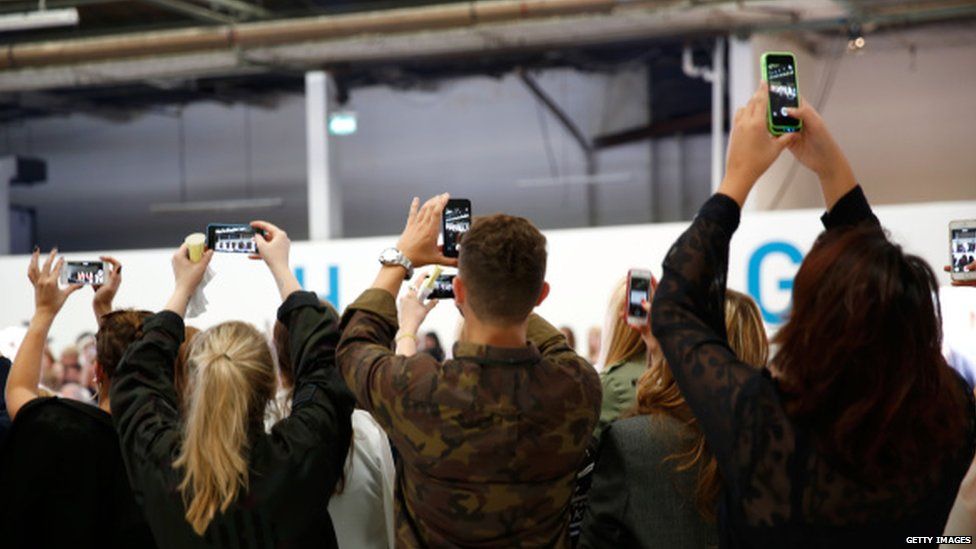
The use of social media by fashion insiders is artificially speeding up the fashion calendar, because customers are seeing fashion instantly as it hits the runway. Josh Newis-Smith, the junior fahion editor for Grazia magazine reckons this obsession with capturing and sharing every earring and handbag on the runway is changing how the fashion industry works. "We're all watching a show through our phone, rather than our eyes," he says. "Social media is now so relentless, you are spending your whole time on Instagram, Snapchat, Twitter, Periscope... Everything needs to be instant." September is the time designers reveal their collections for the following spring and summer.
 Mobile style at London Fashion Week

 A fashion show is not a closed off experience only to be seen by the chosen ones anymore, in the old days, the spring summer collections were seen by customers only in magazines in the following February. This speed up has had a major influence especially on high street brands such as Zara,Topshop or online-only retailer Asos, they have enough resources to create collections inspired by the current fashion month in a matter of weeks and that´s exactly what customers want. By the time designers clothes have got into the stores, the high street has already interpreted their look several ways,it is good for customers, but experts are aware that at some point this pace needs to slow down.


NEW AGE INTERACTION

Instagram fashion accounts with most followers

In the fashion industry, social media platforms can be used to interact with the consumer, as a means of networking with others in the industry, and as a way of building an online presence. But social media can also influence designers in unique ways that are changing the way many designers create their fashions.It’s not just the inspiration and influences on major fashion designers that social media is evolving; it’s also the way we view fashion and the industry as a whole. For decades, a few big names dominated the fashion industry in a very top-down fashion but now social media has acted as a catapult to push the “unknowns” into situations where they can make their designs and ideas known to millions.The Blogger´s effectiveness is due to a strong individual, personal, popular, and elitist point of view. The engaging experience of a blog offers readers the opportunity to voice opinions and challenge fashion critics.Once considered fashion-obsessed amateurs, now brands view popular bloggers as the new journalists, influencers and trendsetters. 
 Social media sites act as a platform for the average person, and major fashion designers know these people are out there so they can also reap benefits by reaching customers on a new level that is more intimate and interactive, rather than the highfalutin fashion runways. A study from eBay Deals shows that more people are using social media for wardrobe advice, inspiration and the latest trends and fashion related Tweets doubled from the same event just a year earlier. From people sharing Instagram photos and Tweets from the sidelines of top fashion runways, people from home can interact and engage in the fashion shows just like the attendees.
Elitism within fashion has been hugely eroded, and this is for the best. The floodgates have been opened to a new generation – young creatives of multifaceted and sometimes-obscure talents that challenge preconceptions and convention.
Most influential fashion bloggers of now


THE EXTENT OF INFLUENCE 
In this new day and age young shoppers are making important decisions online and learning about fashion via blogs rather than via fashion magazines. What follows is a democratisation of opinion, as young fashionistas can connect with people who really matter to them like designers rather than the traditional journalists. Facebook influences shopping habits of teenage the ‘social shopper’ more than any other medium. Even the smarter, clued-in fashionista-types remain heavily influenced by Facebook, with independent blogs providing a only a little bit more influence. However both Pinterest and Instagram are huge players, just behind the aforementioned Facebook and blogs for multiple age categories. For the first time in history,customers are shaping how brands create and portray themselves. 


Sunday, April 14, 2013


The Internet and New Media: a Revolutionary tool?


On the 8th of April 2012  a post was published here which can be summarised with one sentence: “[…] nowadays New Social Medias play an essential role in the development of revolutions.”
I highly disagree with this view and in the following I would like to make clear why the Internet and Social Media are not (and probably won’t be in the near future) the essential or decisive element in revolutions. The main reason for this is fourfold:

Meaningful symbolism?


1.The Internet is not genuinely democratic!


Cyber-Utopians – as Evgeny Morozov would label them – claim so, however it isn’t. Just as every medium the Internet is a transmission channel, which transfers data from people to other people. This means that it is dependent on its users and its regional and timely context. The indented and the actual uses are not equal. For example although radio played a role liberating former soviet countries, it also played a great role in the Rwandan Genocide promoting hatred and violence. One has to consider that no matter how bad (from a Western point of view) authoritarian rulers are: they always have their supporters. And so although there are examples of the Internet being used to help a revolution or a democratic movement, there are also many examples of the opposite.
In Saudi Arabia for example Internet users are encouraged to search youtube for videos which offend Saudi sensibilities. There was a similar effort in Thailand, brought to live by an MP. At Protecttheking.th users could post links of sites that offended the king and then these sites were blocked. Another example is Iran where the government put photos of protesters online so that citizens who are loyal to the regime can identify them. They basically crowd-sourced the process of putting down a rebellion. In the Arab spring many protesters used Twitter to organise their protest which seemed to work swiftly and effective. However Twitter is a public platform so by organising a Revolution via twitter you are providing your regime with information which they had to torture to gain a decade ago.

The best proof that the Internet is not genuinely democratic is that authoritarian regimes do not fear new media per se. They allow debates about non-political or non-democratic issues like climate change or corruption. They get information what bothers the people they suppress. Therefore by allowing discussion, pretending to listen to the people and sometimes acting, regimes get legitimacy. And if they fear certain websites or initiatives they still can censor the Internet. Most of the time will won’t bother that much because:

2. The Internet is about entertainment not about politics!


People always filter their content and thereby personalize their Internet usage to a degree that they only see what they want to see. Most of the time that’s not political content but tv-series and sports, messages from their family and friends, the newest party-pictures or porn. The Internet is distracting people and confronts them with the familiar. Though “unanticipated encounters involving topics and points of view that people have not sought out and perhaps find irritating, are central to democracy and even to freedom itself” as Cass Sunstein wrote. 
After all we also have to learn from Western Social Media experience. From the 1990s on a lot of people in democracies were highly optimistic about the (direct-)democratic possibilities the internet has to offer. Some imagined a world where everybody was part of the political decision-making process online. What’s left now is mostly resignation. People don’t get involved. There may be more cyber activism in autocracies, however even there most people will use the internet to send harmless mails, watch harmless movies or read harmless thoughts.

Preferences


3. Social Media are not that popular!


At least they are not for a majority of the people in autocracies, due to the countries these autocracies are based in often being less technologically advanced. The number of twitter activists is small, no matter if we are talking about Iran or Moldova. A lot of the Revolutionary supporters on twitter are feel-good-activists from the democratic West. Furthermore most of the supporters in the concerned countries are young, modern, tech-savvy and support Western values. This can lead to a wrong picture of an uprising as it has happened in the Arab spring. In the period of the uprising in Egypt Western Media were highly optimistic that once Mubarak is gone, there will be a western style democracy to replace it. What happened: the people of Egypt chased an anachronistic Western style autocrat out of Heliopolis palace only to vote an Islamic autocrat into office. The Social Media activity of young, modern people created the vision that they and their views of life represent the majority in their country. However once Mubarak was overthrown you can see the deep borders, which divide the protesters from the start.
So who wants to get a false impression will get a false impression and that’s what happens in the Western World. The media loves stories about social media revolution. They are modern and thrilling. Beside the wrong estimation of the usage of Social Media, this view disregards also social and cultural factors and is build on a deterministic picture of technology and media. But having an iPod doesn’t make you a supporter of democratic values.

4. Social Media activism is not binding!


Democratic movements and uprisings demand a great deal of their supporters. It is dangerous, very often even life-threatening to participate. So what are possible reasons to get involved? The idea that just some Social Media posts from strangers will let you protest on the street is naïve. The decisive element was and will be personal tiers with other protesters. 
And your best friends can write you a text message with their mobile phone as well or can just come around. Mouth-to-mouth-propaganda will play an important role for every coming uprising. Especially when regimes start working on their Internet spying it’s the safest way. 

The Tahrir Square after Mubarak resigned 2011

Conclusion


Social Media and the Internet can in some cases be a helpful instrument to bring down regimes; but so can machine guns. And as the latter Social Media and the Internet can be used against protesters. So the outcome of a revolution depends more on the potency or impotence of the regime and the amount and the will of protesters than on the use of Social Media.
In the Western world we have a wrong image of the on-goings in autocracies because we are fond of the idea that our new media technology will change the world to better.
The point is: Wherever you will find a new media revolution you will find a new media counter-revolution. Thanks to thinkers like Morozov this idea is spreading in the World. In relation to that even some of the most famous supporters of the revolutionary effects of New Media already changed or weakened their opinion.

Monday, April 8, 2013

Want to be a full time blogger or freelance journalist? Embrace your social media presence


Perhaps the most crucial thing a blogger or journalist can do before going full time and independent, is to build up a name for him or herself. It is easier said than done, but in the age of new media and social networks the task is more manageable. There are a few examples in the world, but also in a 5-million country as Slovakia it is possible and some made it happen.


Perfect English, perfect starting point

Important thing to say about Slovakia, that the official language is Slovak, which is not spoken anywhere in the world, therefore the audience is limited only to the size of the country. If you speak English, half of the job is done for you already. According to statistics, 15% of the planet speaks it, which means one in seven anywhere in the world.

Let others know what you do

Writing (reporting in the case of journalists) is fundamental, but it's just a start. Before social media took over, only thing to do was to e-mail your articles to some friends and hope search engines will think it is important. Today, you have it much easier. Stuff – articles, blogs, videos, pictures – spreads much easier via social media.

An open Facebook or Twitter account, ideally both, make you easier to find, more accessible and if anyone likes your writing they will not only follow but also share it among their friends. There is no telling how much followers are enough to make you independent, but it's sure it won't happen over night. Let's look at some full time bloggers and freelance journalists and their path to independence.


Brain pickings based on donations

The idea of Maria Popova's website Brain Pickings is simple. She provides inspiration. Her blogposts ranges from book reviews (mostly old) to famous quotes, uncovered old letters of literary classics or vintage ilustrations of all kinds. Today, this is her living. “I want to build a new framework for what information matters,” she says.

It all started out at her workplace where she took charge over sending every week an inspirational newsletter to all her colleagues in the advertising agency where she worked. Then she began uploading all of it on a website. People seemed to like it and were willing to pay enough so that she do not have to do anything else. At the moment she has 150,000 subscribers to her own newsletter, 263,000 followers on Twitter and 145,714 likes on her Facebook page. She lives out of donations and earns a percentage from books purchased on her recommendation through Amazon.


Freelancer after ten years

Before starting her own website OMediach.com (which translates to english as “AboutMedia.com”), Mirka Kernova worked as a full time journalist for the biggest Slovak daily newspaper. She reported on media for more than ten years. After she became a mother, a thought of freelance job seemed to be a way out. She could be at home, work and raise the kids at the same time.

She started her own blog, reporting on media as she used to. As she put it a big help was starting a Facebook page for the blog and a Twitter feed. News about her activities spread via social media quickly. With enough followers, she started the OMediach.com website. The readers trust her experience and because of this she also has many contacts. The founding is provided through advertisements on her web and a single donator on her blog.


New frontier? Maybe

Social media gave freelancing a better chance at succeeding. Of course it is not only blogging or journalism that benefit from the rise of social media. You hardly find a company nowadays not trying to make social media part of their communication. Even though Google remains the giant serch engine, try to think next time you are looking for something, where are you looking for the information.

Milos Cermak, a czech freelance journalist and big Twitter fan, says he tends to search more and more for information on Twitter. And he is not the only one. It seems, your presence on social media sites is becoming more important than ranking in Google searches.

--

Pictures are taken from Brain Pickings Facebook page.

David Tvrdon